
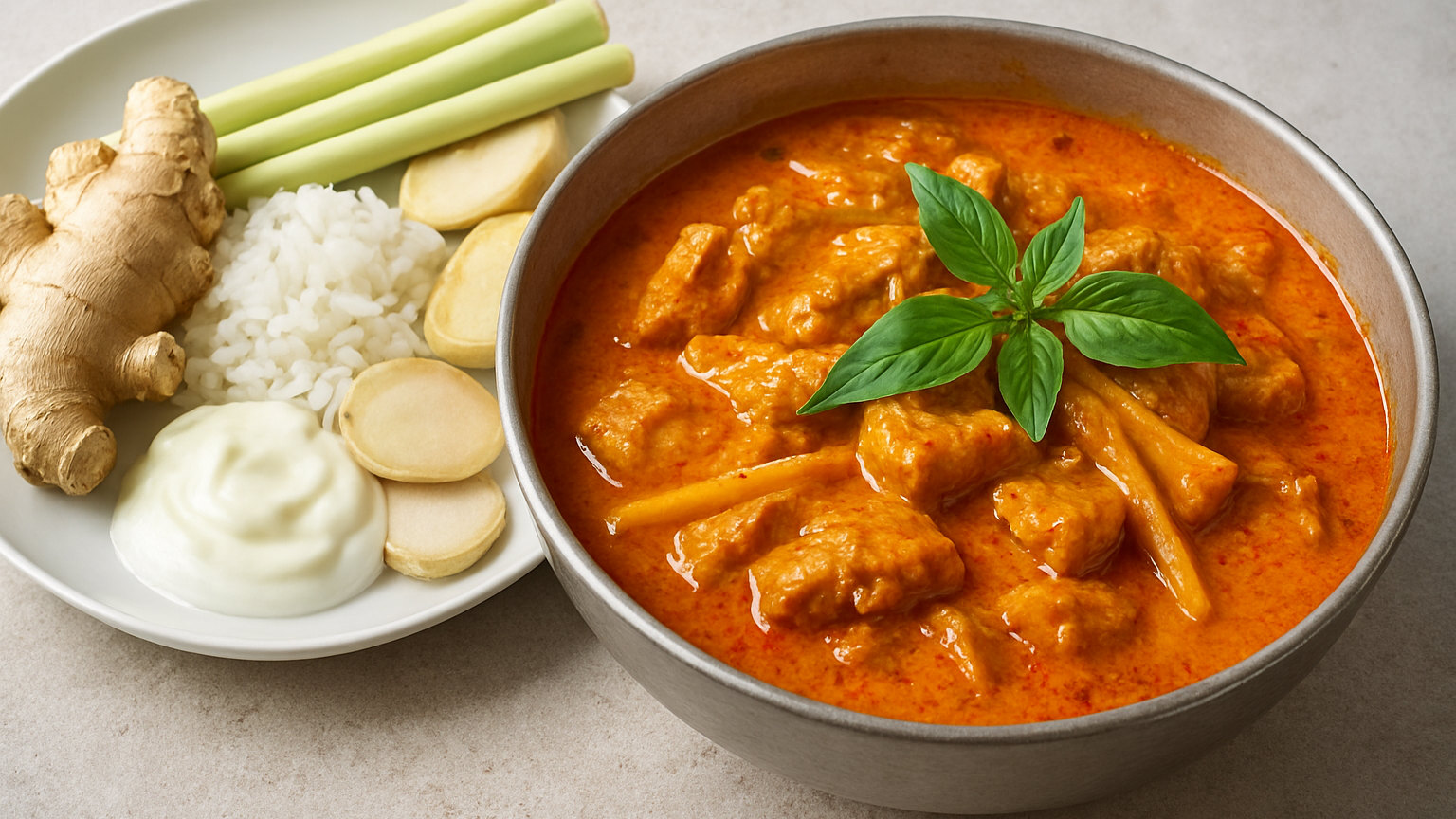
Three fresh aromatics turn up constantly across South and South East Asian cooking. They look broadly similar in the shop and behave completely differently in a pan.
Ginger
Warm, pungent and slightly sweet, used across every cuisine on this site. Buy pieces that are firm with taut skin, avoiding anything wrinkled or soft.
A teaspoon scrapes the skin off far more efficiently than a peeler, following the knobbly shape without waste. It grates, crushes and blends readily.
Galangal
Harder, paler and pinker than ginger, with a sharp piney medicinal quality quite unlike it. Central to Thai, Malaysian and Indonesian cooking, where substituting ginger gives a noticeably milder and wrong result.
It is considerably tougher and needs a heavy knife or a blender rather than a grater.
Lemongrass
A fibrous stalk with a clean citrus aroma. Only the tender lower third is used, and the woody upper section is discarded or bruised and added whole to be removed later.
Peel off the dry outer layers, trim the base, and slice or pound the pale interior.
Are they interchangeable?
No, and this is the important point. Ginger for galangal is the commonest substitution and it produces a dish that tastes broadly right and unmistakably different. Lemongrass has no substitute at all, since nothing else has that specific citrus quality without acidity.
How should you store them?
Freeze all three. Ginger can be grated from frozen straight into a pan. Galangal slices from frozen with a heavy knife. Lemongrass freezes whole or trimmed and is used without thawing.
In the fridge, ginger keeps three weeks, galangal about the same, and lemongrass around two. Freezing costs almost nothing in quality and removes the sourcing problem.
Where do you buy them?
Ginger is in every supermarket. Galangal and lemongrass are reliable at South East Asian grocers, occasionally in larger supermarkets, and both are widely sold frozen.
Buy generously when you find them, since availability is unpredictable and the freezer solves the rest.
Are dried or paste versions any good?
Dried galangal and dried lemongrass have lost most of what matters and are a poor last resort. Tubed pastes are more acceptable and tend to be sharp from the preservatives. Frozen fresh beats both comfortably.
How much do recipes use?
Around 3 to 5cm of ginger or galangal for a curry serving four, and two to four lemongrass stalks. South East Asian recipes use all three more generously than British instincts suggest, and being cautious flattens the dish.
How do you prepare lemongrass?
Trim the base, peel away the dry outer layers until you reach the pale tender core, and use the bottom third. For a paste, slice it thinly across the grain first, since the fibres are tough and a blender will not break them down otherwise.
Should ginger be peeled?
For a smooth paste, yes, since the skin leaves fibrous flecks that never soften. For slices going into a stock or a braise it matters less. Young ginger with thin skin can often be used unpeeled.
Can you grow lemongrass?
Readily, and a supermarket stalk stood in water will root within a couple of weeks and can be potted on. It needs warmth and does well in a conservatory or a bright windowsill. Galangal and curry leaves are far harder.
Should you buy them frozen?
Frozen galangal and lemongrass are widely sold and are very nearly as good as fresh, which makes them the practical default for anyone who cooks South East Asian food occasionally. Fresh ginger is available everywhere, so buying that frozen is rarely necessary.
How long do they keep frozen?
Six months comfortably for all three, and longer without much loss. Lemongrass dries slightly at the edges over time, which does not matter once it is pounded into a paste. Double-bagging prevents the aromas transferring to other things.
Which is hardest to find?
Galangal, which supermarkets rarely stock fresh. South East Asian grocers carry it reliably and frozen versions are widely available online. Lemongrass has become common in larger supermarkets, and ginger is everywhere.


