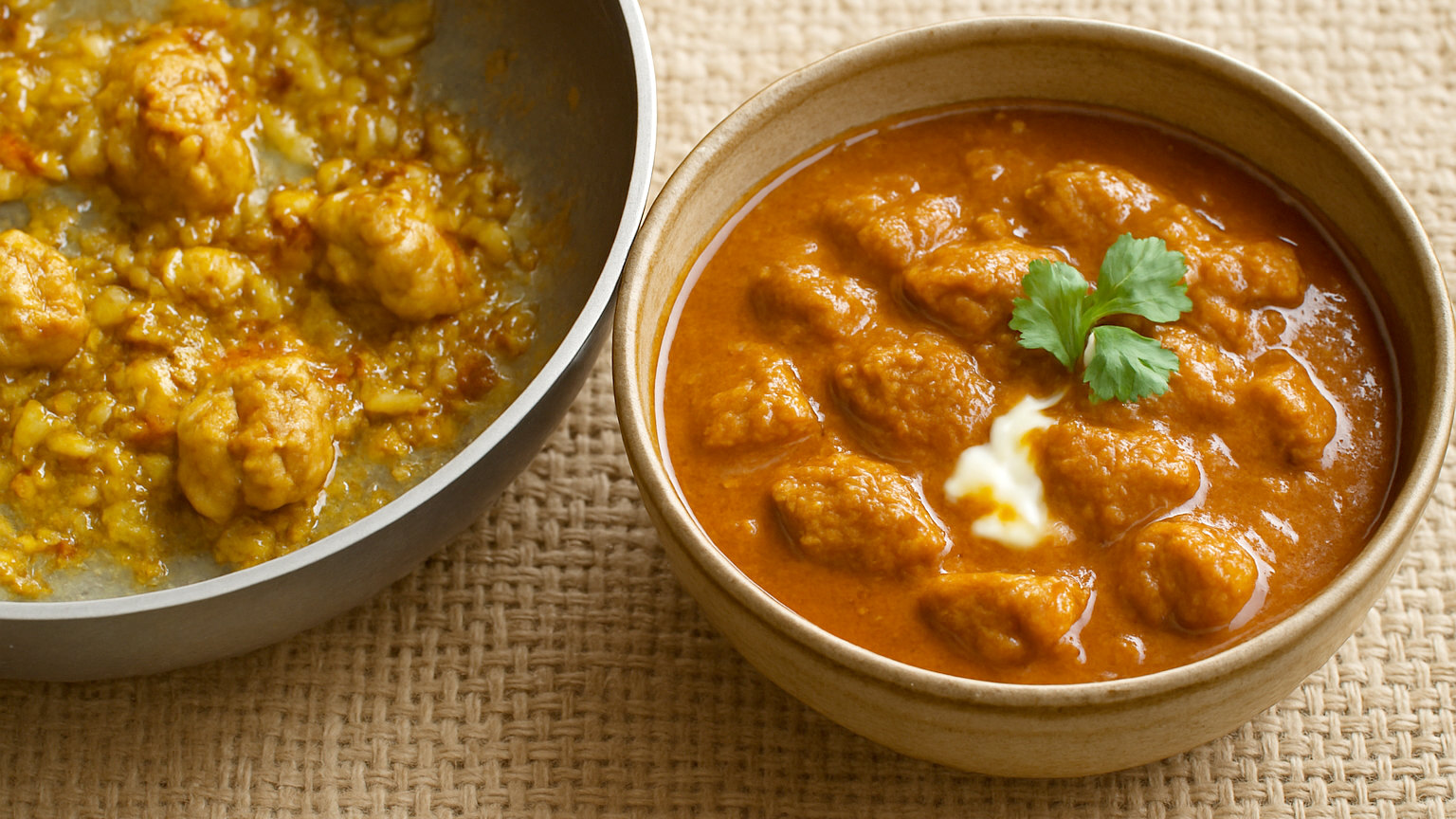
The honest answer is time. Most home cooks give onions six or eight minutes because that is what a recipe headline implies, and the base is then pale, sharp and watery. A restaurant kitchen gives them far longer, and everything built on top of that base tastes different as a result.
What is actually happening to the onion?
Two separate processes. First the cell walls break down and water escapes, which is why a heaped pan collapses to a fraction of its starting volume. Then, once most of that water has gone and the temperature can climb, the sugars caramelise and amino acids react with them to produce hundreds of new aromatic compounds.
That second stage is the one that matters, and it cannot begin while the pan is still steaming. Any recipe promising caramelised onions in ten minutes is describing softened onions.
How long does it take?
For three large onions, finely sliced, in a wide pan over a medium heat, expect 20 to 25 minutes. In a narrow or crowded pan it takes longer, because the steam has nowhere to go and the onions braise rather than fry.
Turning the heat up does not compress this. It scorches the edges while the middle is still releasing water, and burnt onion is bitter in a way that cannot be corrected later. Medium heat and occasional stirring is the whole method.
How dark should they go?
Deep golden brown, the colour of a well-baked pastry crust, with visible browning on the edges and a jammy texture. If they still look yellow and hold their shape, the base is not ready.
There is a further stage used in some Pakistani and North Indian cooking where the onions go almost mahogany. That produces a darker, sweeter, slightly bitter base suited to rich meat dishes, and it takes closer to 35 minutes.
Does it help to add salt or sugar?
Salt genuinely helps and should go in at the start. It draws water out of the onions by osmosis, which speeds up the first stage and shortens the total time by several minutes.
Sugar is a shortcut that mostly cheats the colour rather than the flavour. A pinch will darken the pan quickly without producing the depth that comes from the onions own sugars, and it is easy to end up with something that looks right and tastes flat. Bicarbonate of soda has the same problem, and adds a soapy note if you use more than the barest pinch.
Sliced, chopped or blended?
- Finely sliced browns fastest and gives the most flavour, because there is more surface area exposed to the pan.
- Finely chopped is fine and disappears more completely into the finished sauce.
- Blended to a paste before cooking is common in South Asian home kitchens and gives a very smooth sauce, but it holds far more water and takes considerably longer to drive off.
If you want a smooth restaurant-style texture, brown the onions sliced and blend the sauce afterwards. You get the browning and the texture rather than trading one for the other.
Can you brown onions in advance?
Yes, and it is the single most useful thing to batch. Brown a full pan on a Sunday, cool it, and freeze in portions in an ice cube tray or small bags. Two hundred grams of browned onion dropped into a pan on a Tuesday turns a forty-minute curry into a twenty-minute one, with none of the flavour lost.
Refrigerated they keep for about five days, frozen for three months. This is closer to what a takeaway kitchen does than any other domestic shortcut, because the browning has already happened long before your order arrives.
Which pan should you use?
Wide and heavy beats deep and thin every time. A wide base gives the onions room to sit in a shallow layer, so the water they release escapes as steam rather than pooling around them and boiling them instead. Heavy material, whether cast iron or a thick-bottomed stainless pan, holds its temperature steadily and stops the hot spots that scorch some slices while others are still pale.
A non-stick frying pan works perfectly well and is easier to clean, though you lose the browned residue that sticks to an uncoated base, which is worth having and worth scraping back into the sauce when the tomatoes arrive.