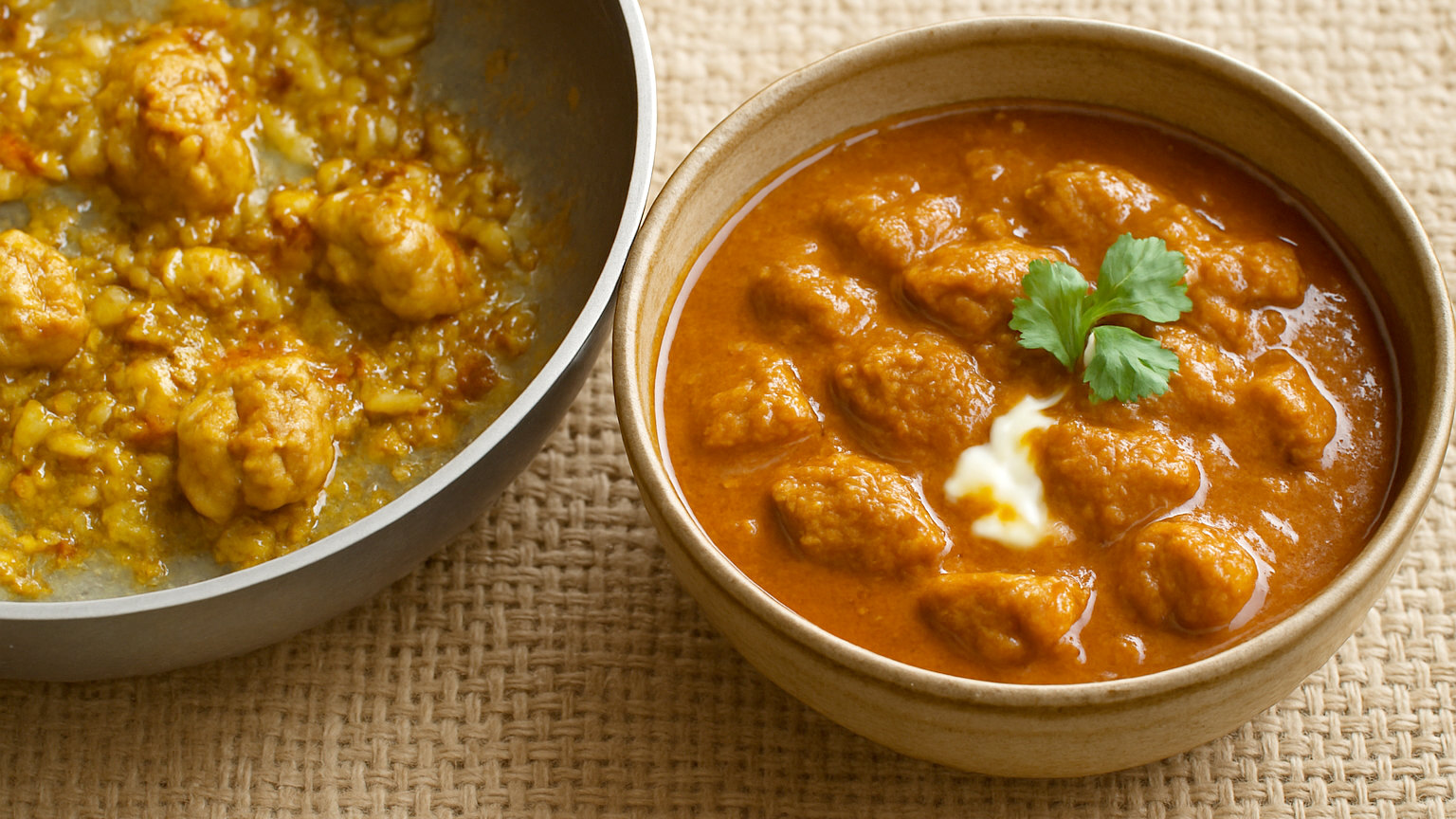
The short answer is that three things separate a good homemade chicken curry from a disappointing one. Cook the onions far longer than feels sensible. Add ground spice to hot fat rather than to liquid. Let the sauce reduce properly before the chicken goes anywhere near it.
Why does a home chicken curry taste thin?
Usually because the onions were softened for six minutes rather than browned for twenty. Onions carry the sweetness that everything else sits on, and that sweetness only appears once the sugars have caramelised and the volume has collapsed by roughly two thirds. A pale onion base gives a sauce with nothing underneath it, and no amount of extra spice will supply what is missing.
The second culprit is ground spice tipped into tomatoes or stock. Ground spices are fat-soluble, so their aromatic compounds need oil and direct heat to release. Dropped into liquid they stay raw and taste faintly dusty, which is the flavour people describe as powdery.
Which cut of chicken should you use?
Boneless thigh, by a clear margin. Thigh carries more fat and connective tissue than breast, so it stays succulent through twenty-five minutes of simmering instead of turning fibrous at twelve. Bone-in thigh is better still if you do not mind eating around the bone, because the bone releases gelatine that gives the sauce body.
How much oil does a curry need?
More than feels comfortable, and this is where domestic cooks flinch. Four tablespoons for four portions is normal. The oil is doing work rather than sitting there: it carries the spice, it browns the onions evenly, and at the end it separates out and glosses the surface, which is the visual signal that a sauce has reduced far enough.
Everyday Indian chicken curry
Serves four. Around fifteen minutes of preparation and fifty minutes of cooking.
Ingredients
- 800g boneless chicken thigh, cut into large chunks
- 4 tbsp vegetable or sunflower oil
- 3 large onions, finely sliced
- 6 garlic cloves and a 4cm piece of ginger, crushed to a paste
- 2 tsp ground coriander
- 1 tsp ground cumin
- 1 tsp ground turmeric
- 1 to 2 tsp Kashmiri chilli powder
- 400g tin chopped tomatoes
- 1 tsp salt, plus more to finish
- 250ml hot water
- 1 tsp garam masala
- A handful of fresh coriander, chopped
Method
- Heat the oil in a wide heavy pan over a medium heat. Add the onions and a pinch of salt and cook for 20 to 25 minutes, stirring every few minutes, until they are deep golden brown and greatly reduced in volume. Do not rush this stage.
- Add the garlic and ginger paste and fry for 2 minutes, until the raw smell has gone.
- Turn the heat down. Add the coriander, cumin, turmeric and chilli powder and stir constantly for 45 seconds. The mixture will look dry and smell strongly aromatic. Splash in a tablespoon of water if it threatens to catch.
- Add the tomatoes and the salt. Cook for 10 to 12 minutes over a medium heat, stirring often, until the mixture darkens and oil begins to pool at the edges of the pan.
- Add the chicken and turn it through the sauce until every piece is coated. Cook for 5 minutes.
- Pour in the hot water, bring to a simmer, cover partly and cook for 20 minutes, stirring occasionally.
- Uncover and simmer for a further 5 to 10 minutes, until the sauce clings to the chicken rather than pooling around it.
- Stir in the garam masala, check the salt, and scatter the fresh coriander over before serving.
How do you know when it is finished?
Watch for the oil separating and rising to the surface in small glossy pools around the edge. That tells you the water has driven off and the emulsion has broken the right way, which is exactly the point at which the flavours stop tasting like separate ingredients. A sauce that still looks like tomato soup needs another ten minutes uncovered.
What can you change safely?
Swap the water for chicken stock, add a tablespoon of cream or yoghurt at the end for a rounder finish, or throw in a cinnamon stick and four green cardamom pods with the onions. What you should not change is the length of the onion stage, which is the one shortcut that always shows.