
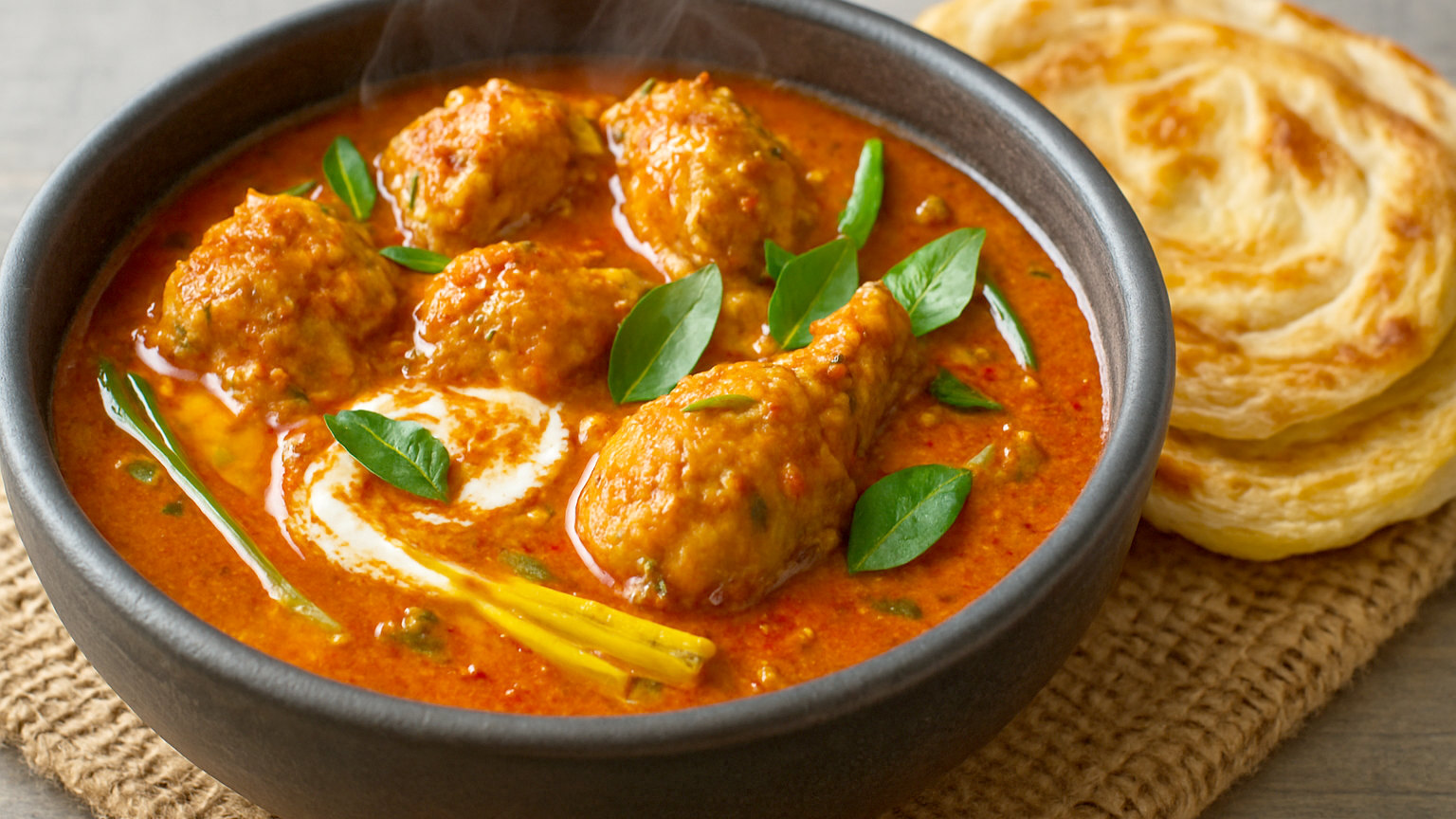
Paste quantities vary enormously between cuisines and recipes are often vague about it, which leaves people either with a thin curry or an overwhelming one.
Thai curries
Two to three tablespoons of homemade paste for a curry serving four, against 400ml of coconut milk. Commercial pastes are usually saltier and more concentrated, so start at two tablespoons and taste.
A jungle curry uses more, since there is no coconut milk to carry it.
Malaysian and Indonesian
Far more, and it is measured differently. A rempah for a curry serving four to six is built from eight to twelve shallots plus everything else, which produces a substantial quantity of paste.
This is the body of the dish rather than a seasoning added to it, which is the key difference from Thai cooking.
Indian wet pastes
A vindaloo paste is used as a marinade at roughly one part paste to five parts meat. A tandoori marinade is similar. These are coatings rather than sauce bases.
Why do bought pastes need less?
Salt, mostly. Commercial pastes carry a great deal of it, so using the quantity a homemade recipe specifies gives an over-salted curry. Two tablespoons of a bought paste is often equivalent to three of your own.
Taste before adding any fish sauce or salt when using a jarred paste.
How do you adjust for heat?
Not by reducing the paste, which weakens everything else along with the heat. Make or buy a milder paste, or add fresh chilli separately to a mild one. Cutting the paste quantity to control heat is the commonest mistake and it produces a thin curry.
Can you use too much?
Yes, and the symptoms are a curry that is harsh, over-salted and unpleasantly intense rather than simply strong. Four tablespoons of a commercial Thai paste for four portions is usually past the point.
How much does a batch make?
A homemade Thai paste recipe typically yields six to eight tablespoons, so two to three curries. A bumbu dasar batch yields around 400g, which covers five or six dishes at three or four tablespoons each.
Should you weigh it?
Tablespoons are fine for Thai pastes. For Malaysian and Indonesian bases, weighing is more reliable, since a tablespoon of a thick fried bumbu and a tablespoon of a loose one are quite different quantities.
Does the dish size change it?
Not proportionally. A curry for eight does not need twice the paste of a curry for four, since the sauce volume scales differently from the protein. Around one and a half times is a better starting point, tasted and adjusted.
What if the curry tastes weak?
Fry another tablespoon of paste in a little oil in a separate pan and stir it in, rather than adding raw paste to the finished sauce. Raw paste added late tastes sharp and does not integrate, which makes the problem worse rather than better.
How do you measure a wet paste?
By weight for anything thick, since a heaped spoon and a level one differ enormously with a stiff paste. Around 20g per tablespoon is a reasonable conversion. For loose Thai pastes, spoons are accurate enough.
Does the protein change the quantity?
Slightly. Fish and prawns carry flavour less well than beef or lamb, so they generally want a little more paste rather than less. Vegetables sit somewhere between. The coconut milk volume matters more than the protein does.
How much for a large batch?
For a curry serving eight, around four tablespoons of Thai paste rather than the six that doubling would suggest. Paste quantities scale sub-linearly, so tasting partway through is more reliable than arithmetic.
Does the coconut milk volume matter?
More than the number of servings. Two tablespoons of paste to 400ml of coconut milk is the useful ratio for a Thai curry, and holding that proportion as you scale gives more consistent results than working from portions.
Is there a minimum?
Around a tablespoon and a half per four portions for a Thai curry, below which the dish tastes of coconut milk with a hint of something else. If you are reducing paste to control heat, you have already gone past the point where the curry works.


