
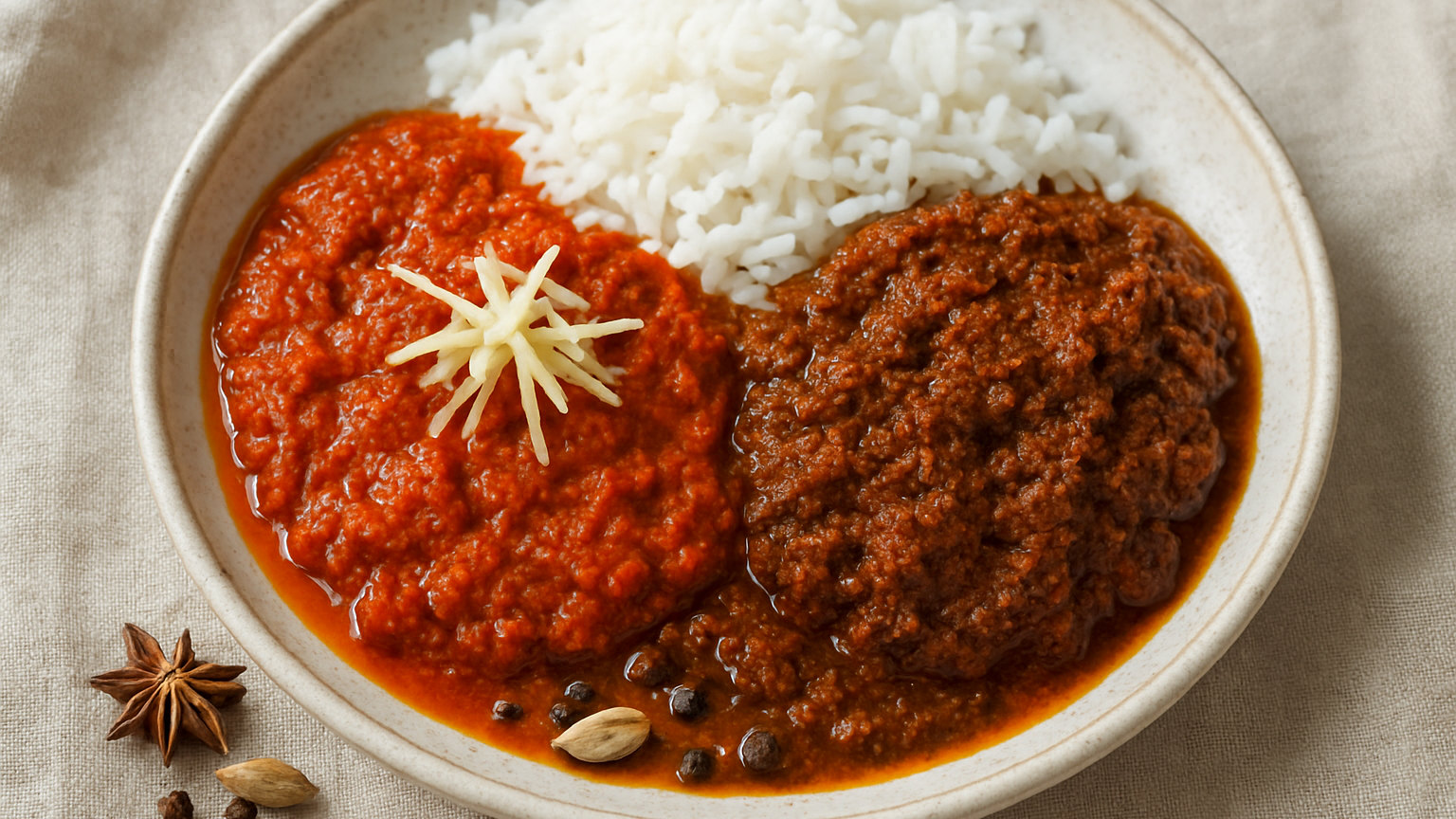
Standing in front of one tub of red curry paste with a recipe calling for something else is a common position. Some substitutions work and most of the tempting ones do not.
Which work within Thai cooking?
Red and panang are close, since panang is essentially a red paste with peanuts and extra spice. Adding two tablespoons of ground roasted peanuts to red paste gets you most of the way.
Red for massaman works less well, since massaman carries cinnamon, cardamom and clove that red does not. Adding those helps.
Which do not?
Green for red or the reverse. They use different chillies and quite different herb balances, and green paste carries a large quantity of fresh coriander root and basil. The colour is the least of the differences.
Can you use Thai paste in a Malaysian dish?
Poorly. A Malaysian rempah is shallot-dominant with candlenuts and belacan and is used in far larger quantity. Thai paste is lemongrass and galangal forward, saltier and used sparingly.
Substituting gives a dish that tastes vaguely South East Asian and like neither cuisine.
What about Indian and South East Asian?
No. A vindaloo paste is vinegar and dried chilli with no fresh aromatics at all. A Thai green paste is fresh herbs with no vinegar. They are not doing comparable jobs.
Which adjustments actually help?
- Red to panang - add ground roasted peanuts.
- Red to massaman - add cinnamon, cardamom, clove and tamarind.
- Any Thai paste - refresh with fresh lemongrass and lime leaf.
- Commercial to homemade quality - add fresh chilli and toasted shrimp paste.
- Yellow to red - add dried chilli, and accept it will be milder.
What is the general rule?
Substitutions work when the two pastes share their aromatic base and differ in additions, since additions can be added. They fail when the base itself is different, since you cannot subtract.
Is it better to change the dish?
Usually. If you have red paste and a recipe wants green, cooking a red curry properly gives a better dinner than an approximated green one. The dish you can make well beats the dish you are trying to fake.
Does the quantity change?
If you are substituting a hotter paste for a milder one, reduce it slightly and add fresh chilli to compensate for the lost body. Otherwise keep the quantity and adjust the seasoning at the end.
What about vegetarian substitutions?
Most commercial Thai pastes contain shrimp paste, so a vegan version needs either a specifically labelled paste or a homemade one. Leaving the shrimp paste out and adding a little white miso covers some of the savoury depth from a different direction.
Can you blend two pastes?
Within a cuisine it occasionally works, and half red and half massaman is a reasonable approximation of panang. Across cuisines it produces something muddled. Mixing a Thai paste with a rempah gives a dish that tastes confused rather than complex.
Does the paste age differently?
An older paste is milder and flatter rather than different in kind, so a tub that has been in the fridge a month may need a little more than the recipe says. Refreshing it with fresh lemongrass and lime leaf in the pan is more effective than simply adding more.
What if you only have curry powder?
You are making a different dish, and that is worth accepting rather than fighting. A dry powder has no fresh aromatic base, so a Thai curry made with curry powder is not a poor Thai curry but something else. Cook an Indian-style curry instead and enjoy it.
Does the colour matter?
Less than the composition, and it is a poor guide. A pale bumbu and a Thai yellow paste look similar and taste nothing alike. Judging by appearance is how people end up substituting across cuisines and being disappointed by the result.
What is the safest swap?
Red for panang, since the two share a base and differ mainly in the peanuts and extra spice that panang carries. Everything else on the list involves subtracting something, which cannot be done once a paste is made.


