
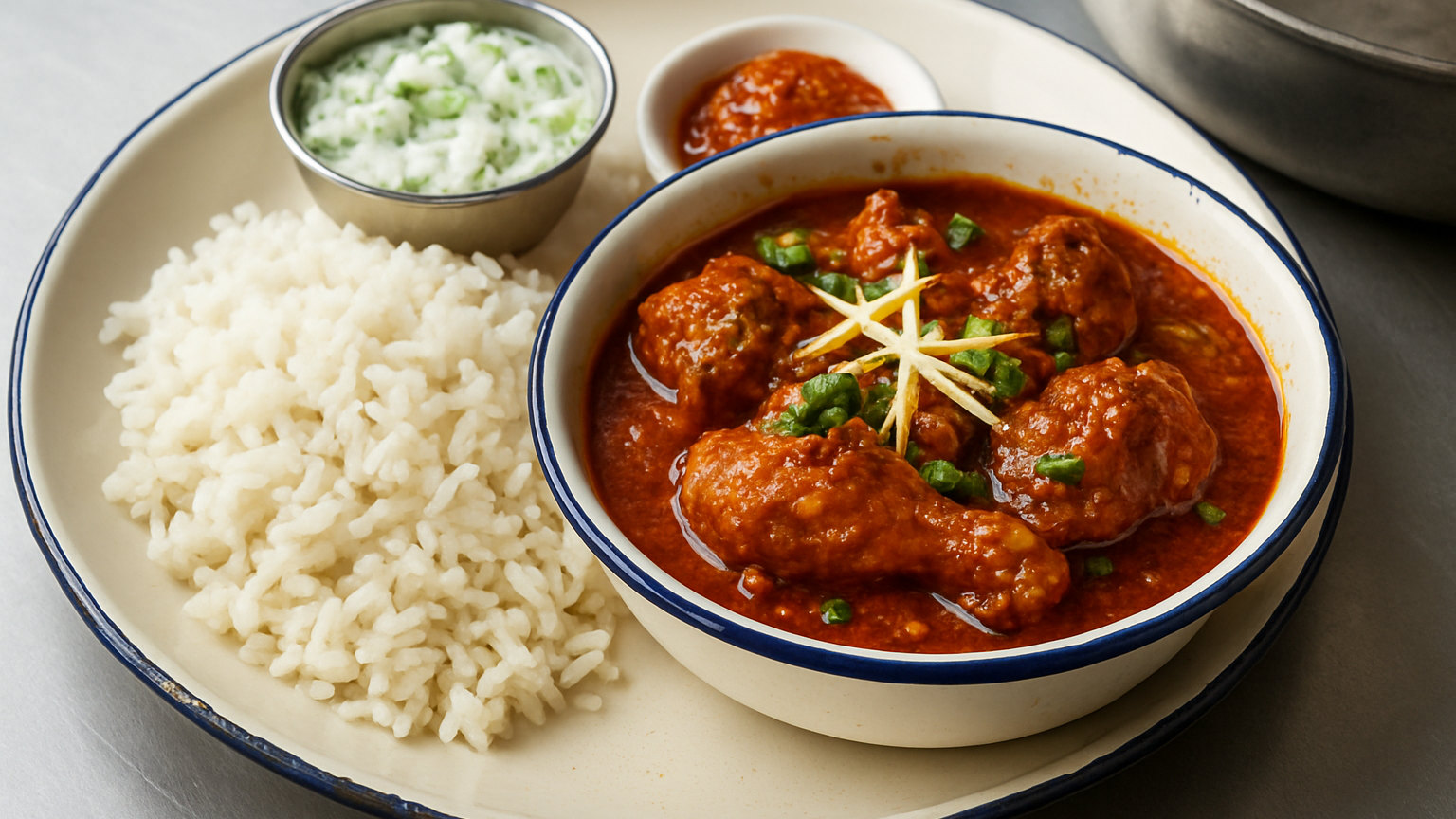
A curry-house table can end up carrying eight dishes, most of which are doing the same job as something else. Three roles cover what a curry actually needs.
Something starchy
Rice or bread, and usually one rather than both. It absorbs the sauce, dilutes the heat per mouthful and provides the bulk of the meal.
Which one depends on the dish. A thin gravy wants rice. A reduced clinging sauce such as a karahi or a bhuna wants bread.
Something cooling
Raita, plain yoghurt or a coconut-based dish. Dairy is the only thing that genuinely reduces the sensation of chilli heat, since casein binds capsaicin in a way water cannot.
With a mild curry it is optional. With anything hot it earns its place.
Something sharp
A raw salad, a pickle or a squeeze of lemon. Curries are rich, reduced and fatty, and a plate of them alone becomes heavy quickly. Acidity and raw texture cut through it.
Kachumber, a plain onion salad or a chopped tomato and cucumber dish all do this.
What is optional?
- Papadums - crunch, pleasant and not structural.
- Bhajis and pakoras - a starter rather than a side.
- Chutney - sweetness, in small quantities.
- A second curry - only if it contrasts with the first.
- Dal - which is a dish in its own right.
What is the common mistake?
Filling the same role several times. Rice, naan and a bhaji is three starches. Two rich creamy curries with no salad is all richness and no relief. The plate feels heavy without anyone being able to say why.
Does every cuisine work this way?
Broadly. A Sri Lankan rice and curry plate contrasts dark against pale and wet against dry deliberately. A Malaysian meal pairs rice with a sambal and an acar pickle. The specifics differ and the logic of contrast holds.
What is the minimum?
Rice and a curry is a perfectly good meal. If you add one thing, make it something sharp rather than something else rich, since that is the gap most home cooks leave.
Does the curry itself change what you need?
Considerably. A very hot dish needs the cooling element more than the sharp one. A rich creamy korma needs the sharp element and no cooling at all. A dry rendang needs something wet, which is a fourth role that only dry dishes create.
What about a second curry?
Only if it contrasts. Two rich tomato-based curries side by side taste like one curry served twice, where a meat curry alongside a dal or a dry vegetable dish gives the plate somewhere to go. Contrast is the whole point of a second dish.
Do drinks count?
Lassi genuinely does, since it fills the cooling role in liquid form and is the traditional answer to a fierce curry. Beer and water do very little for heat, whatever the reputation, since capsaicin does not dissolve in either.
What is the minimum for guests?
One curry, rice, a raita and a sharp salad. Four items, three of which are assembly rather than cooking, and it covers every role a curry plate needs. Adding a bread makes it generous and nothing beyond that is required.
Does it change by cuisine?
The roles hold and what fills them shifts. Thai food uses a sharp herb salad where an Indian meal uses kachumber. Sri Lankan plates use pol sambol for the sharp element and kiri hodi for the cooling one. The structure is more portable than the specific dishes.
Is dal a side?
It sits awkwardly in the category. In South Asia it is a dish in its own right and often the centre of a meal rather than an accompaniment to one. Serving it alongside a curry is fine, and it should be counted as a second dish rather than a side.
Where do pickles fit?
Into the sharp role, in very small quantities. A quarter teaspoon of lime pickle at the edge of a plate does the same job a salad does, which is why both are rarely needed. It is punctuation rather than a side dish.


