
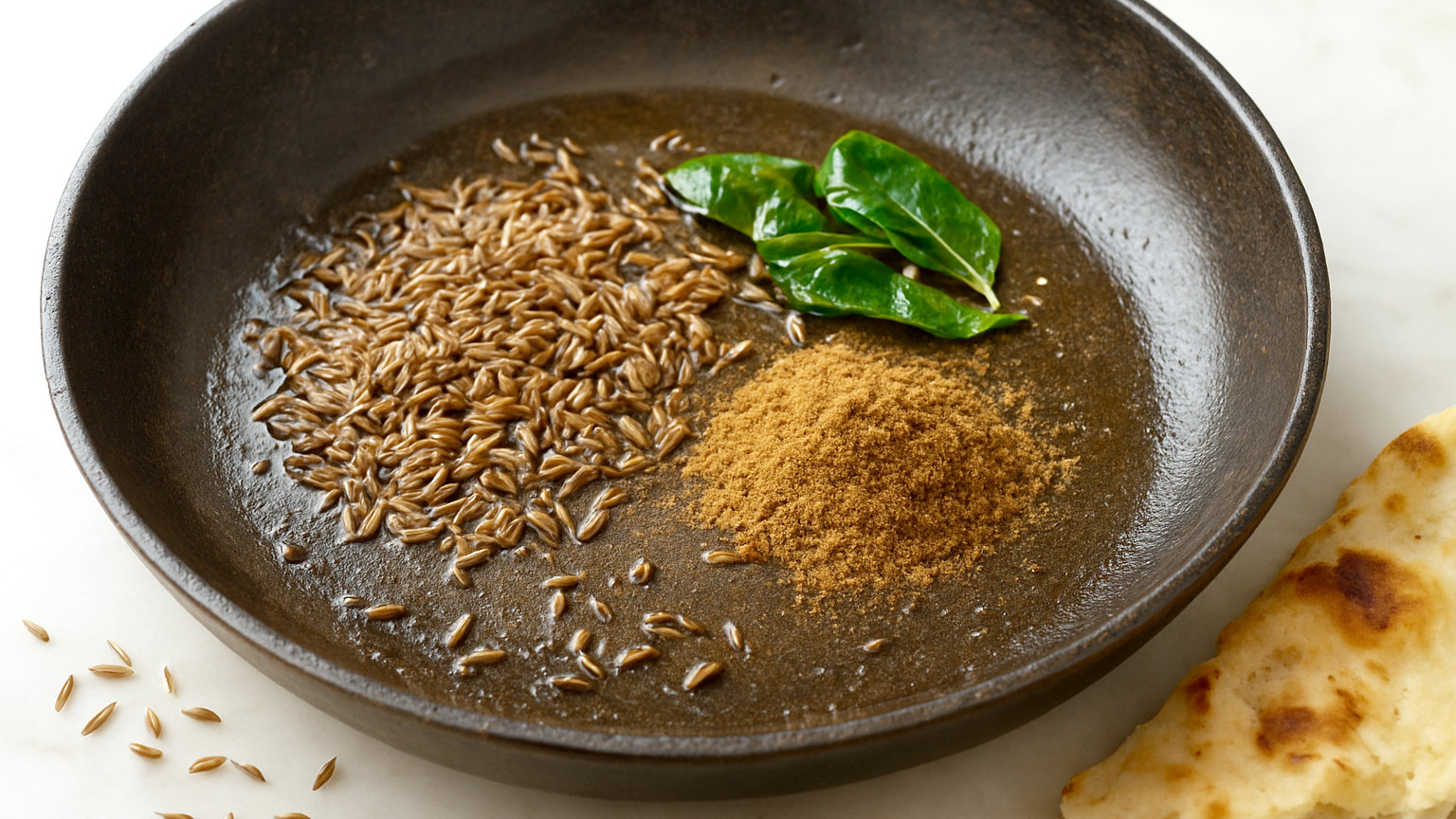
If you asked someone to describe the smell of curry, they would most likely be describing cumin. It is the most recognisable single note in the spectrum and it appears in a large majority of savoury South Asian dishes.
What does it taste like?
Earthy, warm and slightly bitter, with a faint smokiness. It is assertive rather than subtle, which is why quantities are usually modest relative to coriander.
The dominant compound is cuminaldehyde, which is fat-soluble, so cumin needs hot oil to release properly.
How do whole and ground differ?
Whole seeds go into hot fat at the start and release slowly, giving a background warmth and occasional bursts of texture and flavour. Ground cumin goes in later and disperses evenly through the whole dish.
Most curries use both, and they are not interchangeable in timing.
How much do you use?
Around a teaspoon of ground cumin in a curry serving four, against two teaspoons of coriander. Half a teaspoon to a teaspoon of whole seeds in the tempering.
It is easy to overdo, and too much gives a heavy, slightly acrid result that dominates everything else.
Does toasting help?
Considerably. Dry-roasting whole seeds for two or three minutes until they darken and smell strongly, then grinding, gives a far deeper and nuttier result than pre-ground cumin from a jar.
Roasted ground cumin is also used as a finishing sprinkle over raita and salads, where its toasted quality is the point.
What is black cumin?
A different and more expensive spice, smaller and darker, with a sweeter and more complex flavour. It appears in Kashmiri and Mughal cooking and in some biryanis.
It is not the same as nigella seed, which is also sometimes called black cumin and is unrelated to either.
Is it the same as caraway?
No, and they are frequently confused because the seeds look alike. Caraway is sweeter and more aniseed-like and belongs to European cooking. Substituting one for the other gives a noticeably wrong result.
What substitutes?
Nothing closely. A blend of coriander with a little caraway approximates the shape without the character. If you have no cumin, the honest answer is that the dish will taste different rather than that a substitute will fix it.
How long does it keep?
Whole seeds hold for a year or more. Ground cumin fades within three to four months, and by six it is contributing very little. Since it is used in small quantities, buying small jars is sensible.
Where does it appear outside curry?
Widely, which is worth knowing when buying. Cumin is central to Mexican, Middle Eastern and North African cooking, so a jar bought for curry will get used elsewhere. That makes it one of the few spices where a larger bag is reasonable.
Should the seeds be crushed?
Sometimes, and coarsely crushed cumin added late gives distinct bursts of flavour rather than a smooth background. Pakistani karahi cooking uses this deliberately, crushing coriander and cumin roughly and adding them in the final minutes.
Does it dominate easily?
More than any of the other base spices. A heavy hand with cumin gives a curry that tastes of one thing, and it is the commonest reason a homemade curry tastes generic. Keeping it to roughly half the coriander quantity is a reliable ratio.
How do you toast it?
Dry pan over a medium heat, no oil, stirring constantly for two to three minutes until the seeds darken a shade and the smell turns nutty. Tip them onto a cold plate immediately, since they will keep cooking in a hot pan and go from toasted to burnt quickly.
What does burnt cumin taste like?
Acrid and bitter, and it carries through an entire dish with nothing able to mask it. Because cumin is often the first thing into hot fat, it is also the most commonly burnt spice in a curry. If it blackens, start the stage again.


