
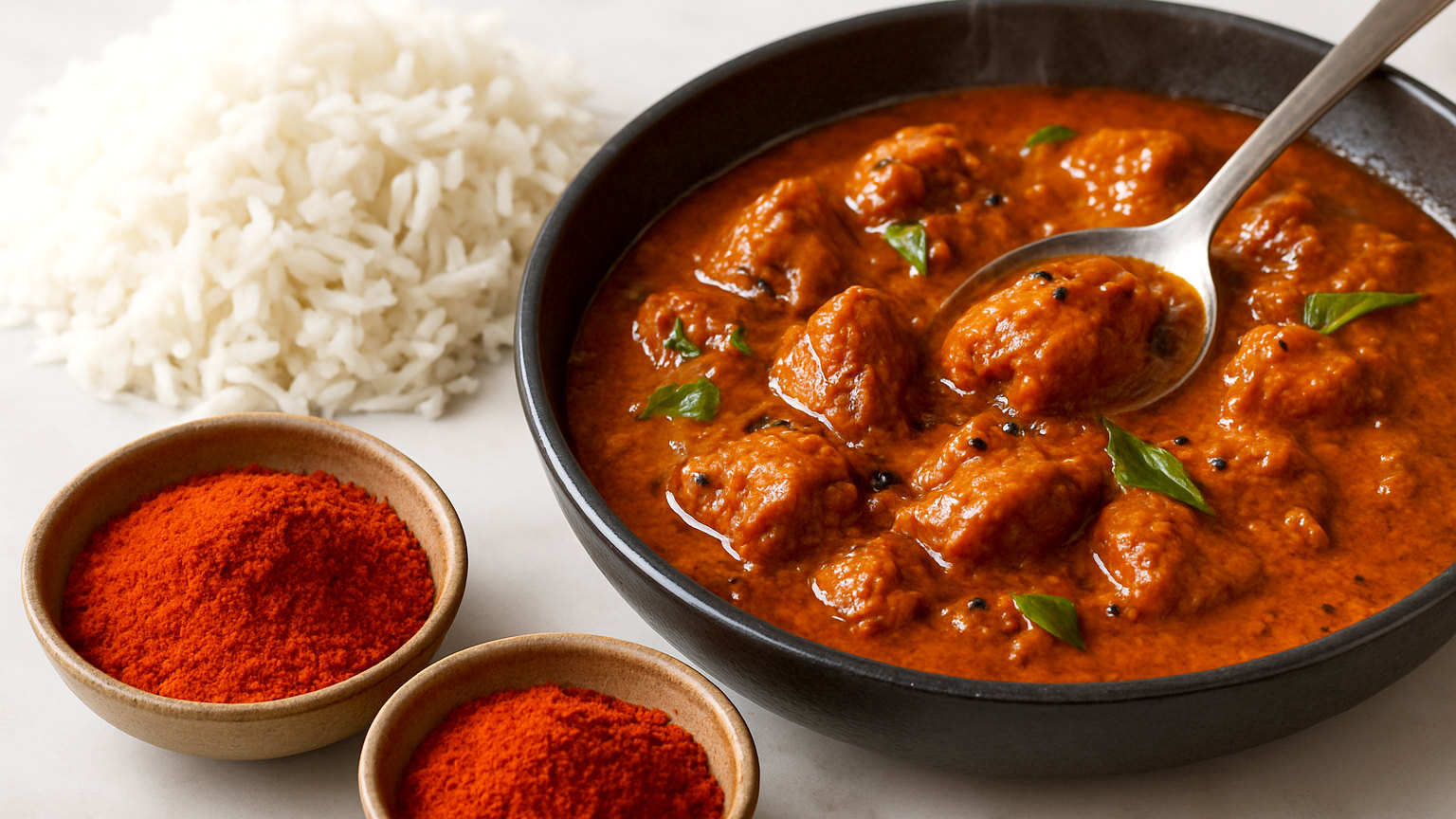
Chilli powder is the spice where the label tells you least. Products sold under the same name vary from barely warm to fierce, and buying two different ones solves the problem permanently.
Why two?
Because colour and heat are separate jobs and one powder cannot do both well. Kashmiri chilli is intensely red and only mildly hot, so it colours a curry deeply without making it fierce. A hotter powder is then added separately in whatever quantity you want.
With one all-purpose powder, a deep red curry is necessarily a very hot one.
What is Kashmiri chilli?
A variety grown for colour rather than heat, giving a vivid red and a mild fruity warmth. It is used generously, often two or three teaspoons in a curry for four, which would be unthinkable with a hot powder.
Deggi mirch is a related blend serving the same purpose and is widely available.
What should the hot one be?
Any plain ground hot chilli. Indian grocers sell simple hot chilli powder cheaply. Cayenne is a reasonable equivalent and widely available. What matters is that it is a single ingredient rather than a blend.
What is British chilli powder?
Often a blend rather than pure chilli, containing cumin, oregano, garlic and salt, and formulated for chilli con carne rather than for curry. It is not what an Indian recipe means by chilli powder.
Check the ingredients. If it lists anything besides chilli, it is a blend.
How much should you use?
- Kashmiri - 1 to 3 tsp in a curry for four, for colour.
- Hot powder - quarter to 1 tsp, for heat.
- Together - the usual approach, adjusted per dish.
Does it burn easily?
Very. Ground chilli scorches within seconds in hot fat and turns acrid. Many cooks add it in the last few seconds of the spice stage, or stir it into the fat with the heat already off, which colours the oil brilliantly without burning it.
Does it lose heat over time?
Slowly. Capsaicin is relatively stable and a powder two years old will still be hot. What fades faster is the fruity aroma and the brightness of the colour, so an old jar gives heat without character.
What about flakes?
Useful for finishing rather than for the base, since flakes give uneven bursts rather than distributed heat. Whole dried chillies are the other option, fried in the oil at the start, where they perfume without contributing much heat unless broken.
How hot is a hot powder?
It varies enormously between brands and none of them tell you. A plain Indian hot chilli powder is usually somewhere around the heat of cayenne. The practical approach is to start with half what you think and taste, since you can always add more.
Should you keep whole dried chillies too?
They are useful and cheap, and they do something powder cannot. Whole dried chillies fried in oil at the start perfume the fat without releasing much heat, since the pod stays intact. Broken open they release considerably more, so you have two options from one ingredient.
Does it fade in storage?
The colour fades faster than the heat, which is the reverse of what people expect. An old Kashmiri chilli powder loses its vivid red and keeps whatever mild heat it had. Since colour is the whole point of buying it, replacing it annually is worth doing.
Which is used for tandoori colour?
Kashmiri chilli, usually in quantity, sometimes with a little paprika. The vivid red of restaurant tandoori chicken is partly that and partly food colouring. At home, two or three teaspoons of Kashmiri gives a good red without the dish becoming inedibly hot.
Should you buy a blended curry chilli?
Rarely worth it. Products sold as curry chilli or extra hot blends usually contain fillers and are less predictable than a plain powder. Two single-ingredient powders give more control and cost less. Simplicity is the useful principle in the chilli section.
How do you test a new powder?
Add half what a recipe suggests the first time and taste before adding more. Heat varies so much between brands that a teaspoon of one may equal a quarter of another. One cautious dish tells you where a new bag sits.


