
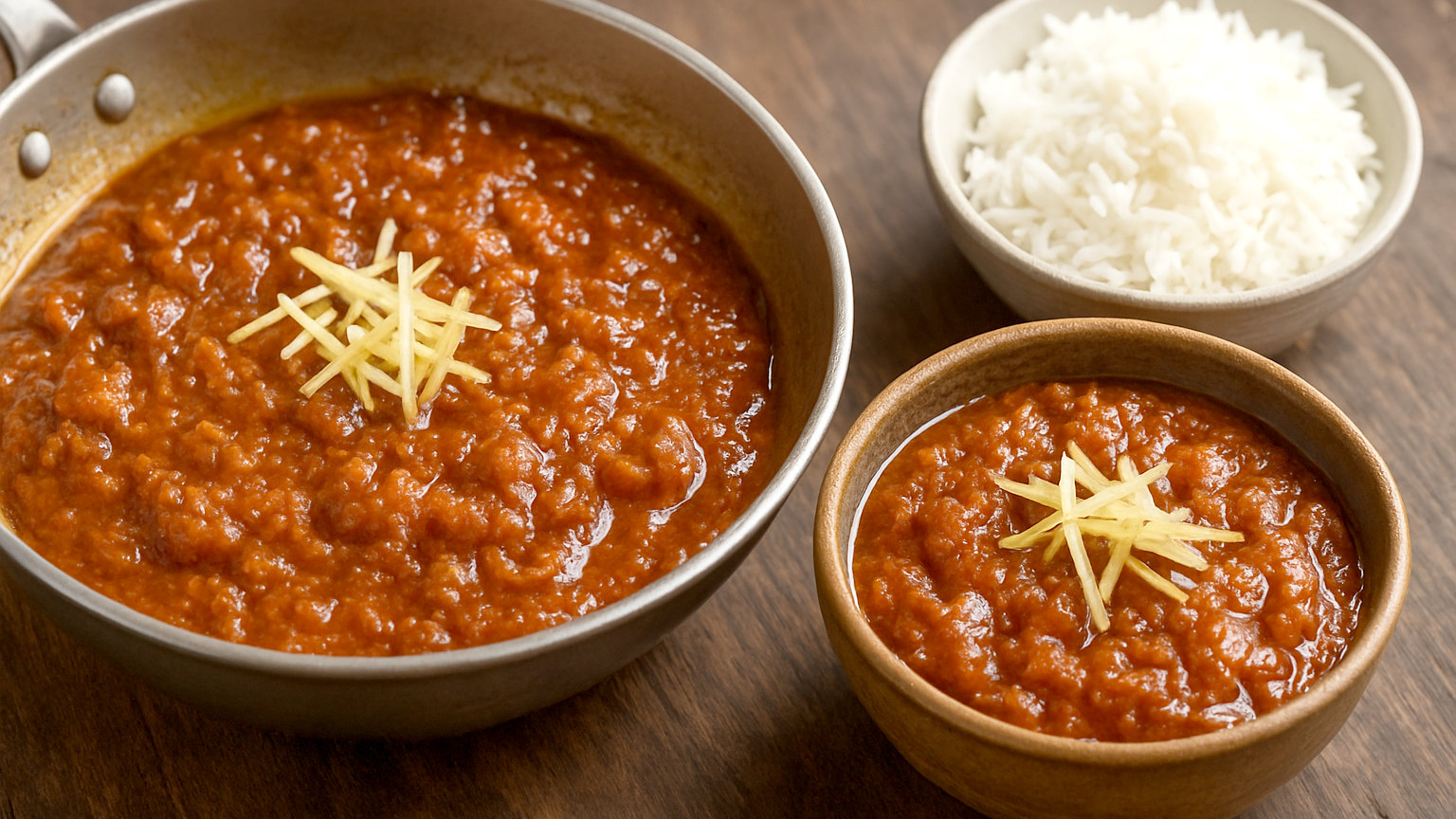
Recipes across South Asian cooking say to cook until the oil separates, usually without explaining what that means or why you would want it. It is the single most useful visual signal in curry cooking.
What is happening?
A masala starts as a suspension of solids in water, with oil dispersed through it. While water is present, the temperature is capped at boiling point and everything is effectively simmering.
As the water evaporates, the mixture concentrates until there is no longer enough liquid to hold the oil dispersed. It coalesces and separates out, and the temperature can now climb well above boiling.
Why does that matter?
Because browning reactions only happen above boiling point. Until the oil separates, no browning is possible, and browning is where a large part of the flavour comes from.
A curry stopped before this point tastes of its separate ingredients. One taken past it tastes like a curry.
What does it look like?
- Pools of clear oil - at the edges of the pan, and coloured by the spices.
- A change in sound - from bubbling to a drier sizzle.
- The masala darkens - noticeably, over a couple of minutes.
- It pulls together - leaving the sides of the pan as a mass.
Tilting the pan is the quickest test. Oil should run clear and free at the edge.
How long does it take?
Ten to fifteen minutes after the tomatoes go in, for a curry serving four. Longer if there is a lot of liquid or the pan is narrow. It cannot be hurried much, since the water simply has to evaporate.
What if it never happens?
Usually there is too little oil, or the pan is too narrow, or the heat is too low. Curries need considerably more oil than most domestic cooks use, and a wide pan evaporates far faster than a deep one.
Should you skim it off?
No. That oil now carries all the fat-soluble aromatics from the spices, and removing it removes a good deal of the flavour. It also gives the finished dish its gloss.
If it looks excessive, the answer is to use slightly less oil next time rather than to remove it now.
Does it apply to coconut curries?
In a different way. Thai cooking deliberately splits coconut cream to release oil for frying the paste. Sri Lankan and Indonesian cooking avoids splitting entirely. Both are using the same physics toward opposite ends.
Is it the same as a curry looking greasy?
No, though the line is fine. Properly separated oil sits as bright pools carrying spice colour. A greasy curry has excess unrendered fat, usually from fatty meat that was never skimmed, and it looks dull rather than glossy.
How much oil do you need for it to happen?
Around four tablespoons for a curry serving four. Below that there simply is not enough oil to coalesce into visible pools, so the signal never appears however long you cook. Under-oiling is the commonest reason a home cook never sees this stage.
Does it happen with every curry?
With any dish built on a fried masala, which covers most Indian, Pakistani and Bangladeshi cooking. It does not apply to a Japanese roux curry, which is thickened rather than reduced, or to dishes where coconut is deliberately kept intact.
Can you make it happen faster?
A wider pan is the most effective change, since evaporation depends on surface area. Chopping the tomatoes finely rather than leaving them in wedges also helps, as does keeping the heat at a genuine medium rather than a gentle simmer.
Is it the same in every cuisine?
The physics is universal and the naming is not. Indian and Pakistani cooking treats it as the standard signal. Durban cooks judge a curry by the red oil on top. Malaysian cooking has a specific phrase for the oil breaking. All three are describing the same moment.


