
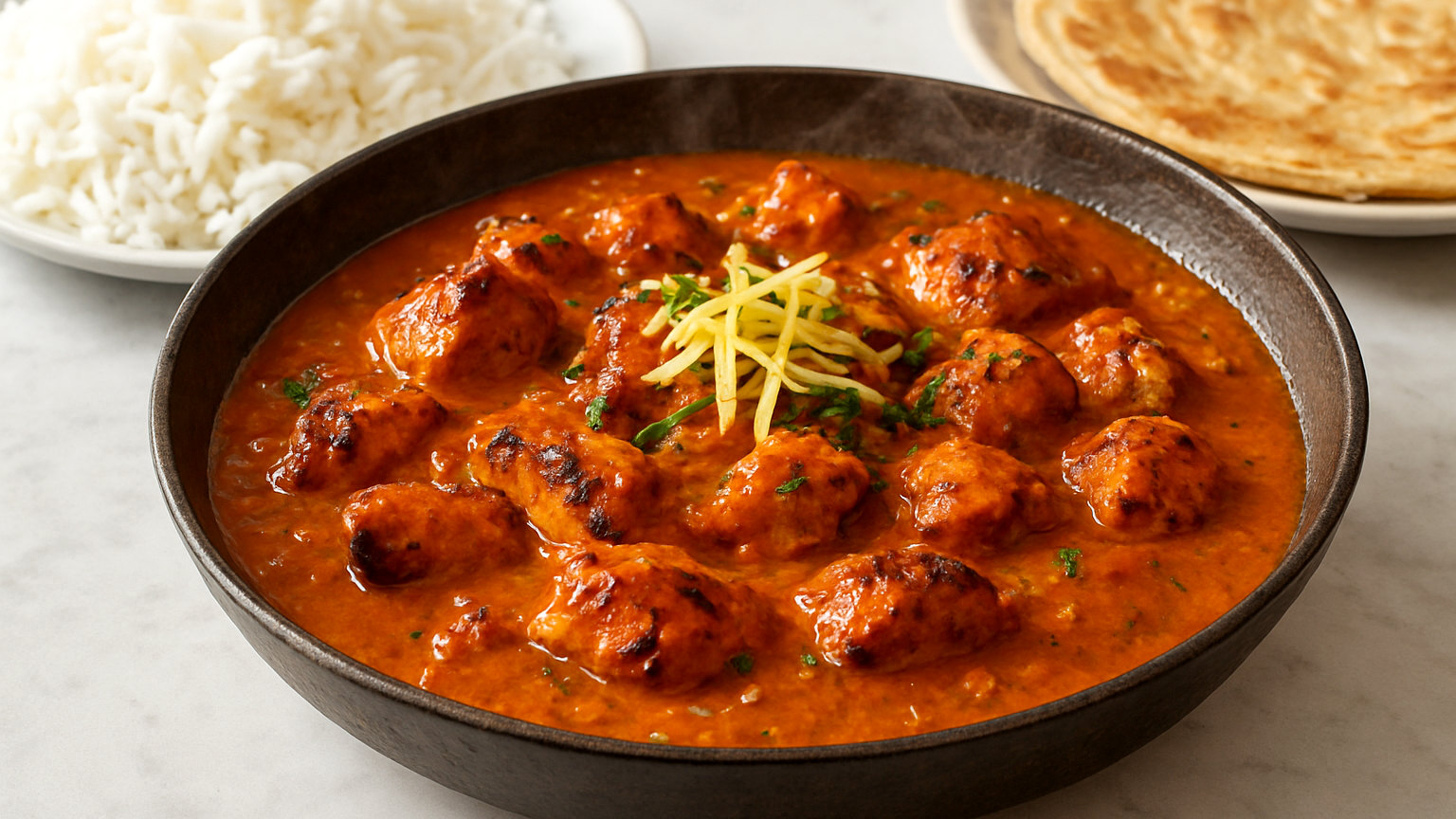
Matching rice to curry is less complicated than it sounds, and the main principle is that the rice should support the dish rather than compete with it.
The regional default
Basmati for Indian, Pakistani, Bangladeshi and British curry-house food. Jasmine for Thai, Malaysian, Indonesian and Vietnamese. Those two cover almost everything on this site.
Getting this right matters more than any refinement on top of it.
When should the rice be plain?
When the curry is heavily spiced, rich or complex. A Sri Lankan black curry, a rendang or a good madras is doing plenty already, and a spiced rice alongside crowds it.
Plain rice also absorbs a thin gravy without contributing competing flavours, which is why aloo gosht and dal are served with it.
When does spiced rice help?
With dry dishes and with dal, where the plate needs more going on. Jeera rice with a dal, or a pilau with a dry meat dish, adds something the curry has not covered.
Where does coconut rice belong?
With Thai, Malaysian, Sri Lankan and Caribbean food, where coconut is already part of the cuisine. Against a North Indian curry it reads as sweet and out of place.
It also works well against fiercely hot dishes, since the fat gives some relief.
Some specific pairings
- Thai green curry - jasmine rice, plain.
- Chicken karahi - naan rather than rice.
- Dal - jeera rice or plain basmati.
- Rendang - plain rice, plus a wet dish alongside.
- Sri Lankan rice and curry - red rice or plain white.
- Cape Malay curry - yellow rice with raisins.
- Japanese curry - short-grain Japanese rice, always.
- Curry-house dishes - pilau rice.
Does bread ever replace it?
Frequently, and it is the default in much of Pakistan and northern India. A karahi, a bhuna or anything with a clinging sauce is better with bread. Rice suits dishes with enough gravy to be absorbed.
Is Japanese rice really different?
Entirely, and it is not a matter of preference. Japanese curry is served over short-grain rice that clumps enough to be eaten with a spoon alongside a thick sauce. Basmati would fall apart under it.
Does any of this matter much?
The basmati and jasmine distinction genuinely does, and the rest is refinement. Plain basmati with almost any South Asian curry is never wrong, and it is a perfectly good default while you work the rest out.
What if you only keep one rice?
Basmati, since it covers the largest number of dishes on this site and is acceptable everywhere except Japanese curry. Jasmine is the second bag to buy if you cook South East Asian food more than occasionally.
Does the rice ever come first?
In biryani and nasi kuning, where the rice is the dish and the curry element is layered through it. Those are exceptions, and for almost everything else the rice is chosen to support whatever the curry is doing.
Does the curry heat change the choice?
A fiercely hot curry benefits from coconut rice or simply more plain rice, since starch and fat both give some relief. A mild dish needs nothing special alongside. That is a more useful consideration than matching by region alone.
Is bread ever the better answer?
Frequently, and it is worth saying in a rice guide. Anything with a clinging reduced sauce, from a karahi to a bhuna to a balti, is better with naan or roti. Rice suits dishes with enough gravy to soak into it.
Does anyone serve both?
Rarely at the same meal in South Asia, where one or the other is chosen. A curry-house meal in Britain routinely brings rice and naan together, which is a local convention rather than something you would meet in Lahore or Chennai.
What is the simplest rule?
Basmati for anything South Asian, jasmine for anything South East Asian, short-grain for Japanese curry, and plain rather than spiced whenever the curry is already complex. Everything beyond that is refinement rather than necessity.


