
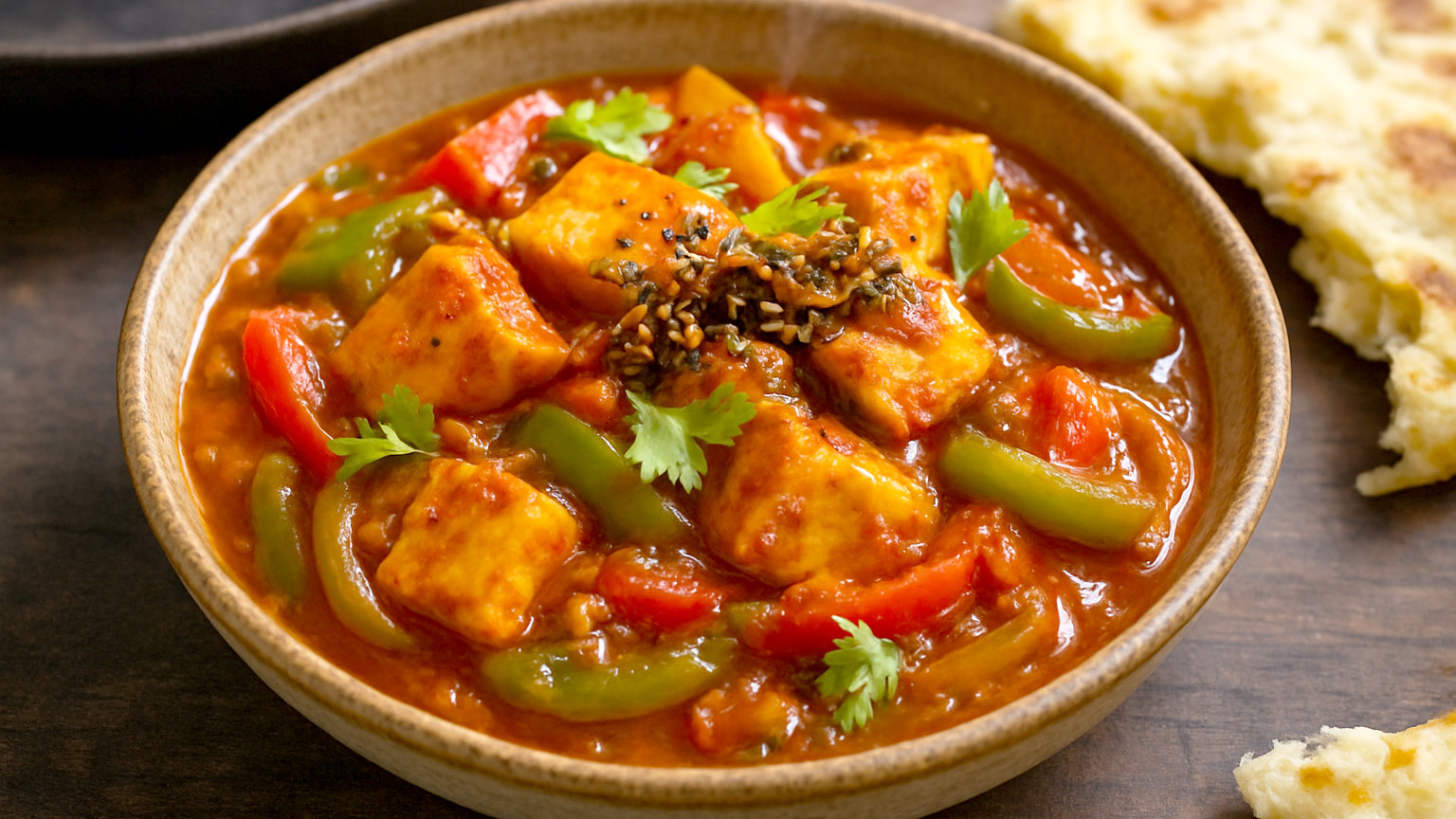
Paneer and a jalfrezi are well suited, because both want the same thing: a very hot pan and a short cooking time. Where paneer struggles in a long braise, it browns beautifully in a stir-fry, and the golden crust it develops is one of the better textures in Indian cooking.
How do you stop paneer going rubbery?
Cook it briefly and separately. Paneer does not melt, and when held at heat too long its proteins tighten and squeeze out moisture, leaving something squeaky and dense. Two minutes a side in a hot pan is enough.
Soaking the cubes in warm salted water for fifteen minutes beforehand helps considerably, softening the surface and adding moisture that buys a margin of error.
Should it be fried before or after the vegetables?
Before, then set aside and returned at the very end. Paneer needs a clean hot pan with a film of oil to brown properly, and it will not colour if it goes in alongside wet vegetables.
It also breaks up if stirred repeatedly, so sear it on two or three faces, remove it, and fold it back in gently for the last minute rather than stirring it through the whole dish.
Paneer jalfrezi
Serves four. Around twenty minutes of preparation and thirty-five minutes of cooking.
Ingredients
- 450g paneer, in 3cm cubes
- 5 tbsp vegetable oil
- 1 tsp cumin seeds
- 2 large onions, one finely chopped and one in petals
- 1 green pepper and 1 red pepper, in 3cm squares
- 6 garlic cloves and 4cm ginger, crushed
- 2 tsp ground coriander, 1 tsp ground cumin, three quarter tsp turmeric
- 2 tsp Kashmiri chilli powder
- 3 tbsp tomato puree and 2 firm tomatoes, in wedges
- 1.25 tsp salt and 100ml hot water
- 4 green chillies, slit lengthways
- 1 tsp garam masala, 1 tbsp lemon juice, fresh coriander
Method
- Soak the paneer cubes in warm salted water for 15 minutes, then drain and pat completely dry.
- Heat 3 tbsp of oil in a pan over a medium heat and fry the cumin seeds for 30 seconds.
- Add the chopped onion with a pinch of salt and cook for 15 minutes until soft and golden.
- Add the garlic and ginger for 2 minutes, then the ground spices on a lower heat for 45 seconds.
- Add the tomato puree for 90 seconds, then the salt and hot water, and simmer to a thick masala for 8 minutes. Set aside.
- Heat the remaining oil in a large frying pan over a high heat. Fry the paneer for 2 minutes a side until golden on two or three faces. Remove carefully.
- Add the onion petals and peppers to the same pan and stir-fry for 3 to 4 minutes until blistered but still firm.
- Add the masala base and the green chillies and stir-fry for 2 minutes.
- Fold the paneer back in with the tomato wedges and cook for 2 minutes, turning gently.
- Add the garam masala and lemon juice, check the salt and finish with coriander.
Which paneer should you buy?
The softest block you can find. Vacuum-packed paneer from a South Asian grocer is usually softer than the supermarket equivalent, which tends to be pressed harder and squeaks more. Homemade paneer is softer still, though it is more fragile in a hot pan.
What about tofu?
Firm or extra-firm tofu works well and makes the dish vegan. Press it for half an hour under a weight to drive out water, then fry it harder and longer than paneer, around three minutes a side, since it needs more time to develop a crust. Cornflour dusted on the surface helps it brown.
Why does paneer stick to the pan?
Because protein bonds to hot metal until a crust forms, and then releases naturally. The mistake is trying to move the cubes too early, which tears the surface off and leaves it welded to the pan. Give each face a full two minutes without touching it, and it will lift away cleanly.
Can you make it ahead?
The masala base yes, the finished dish no. Paneer firms up considerably as it cools and turns dense on reheating, so this is a dish to cook and eat. If you need to prepare in advance, have the base made and the vegetables cut, and do the final ten minutes when people are seated.


