
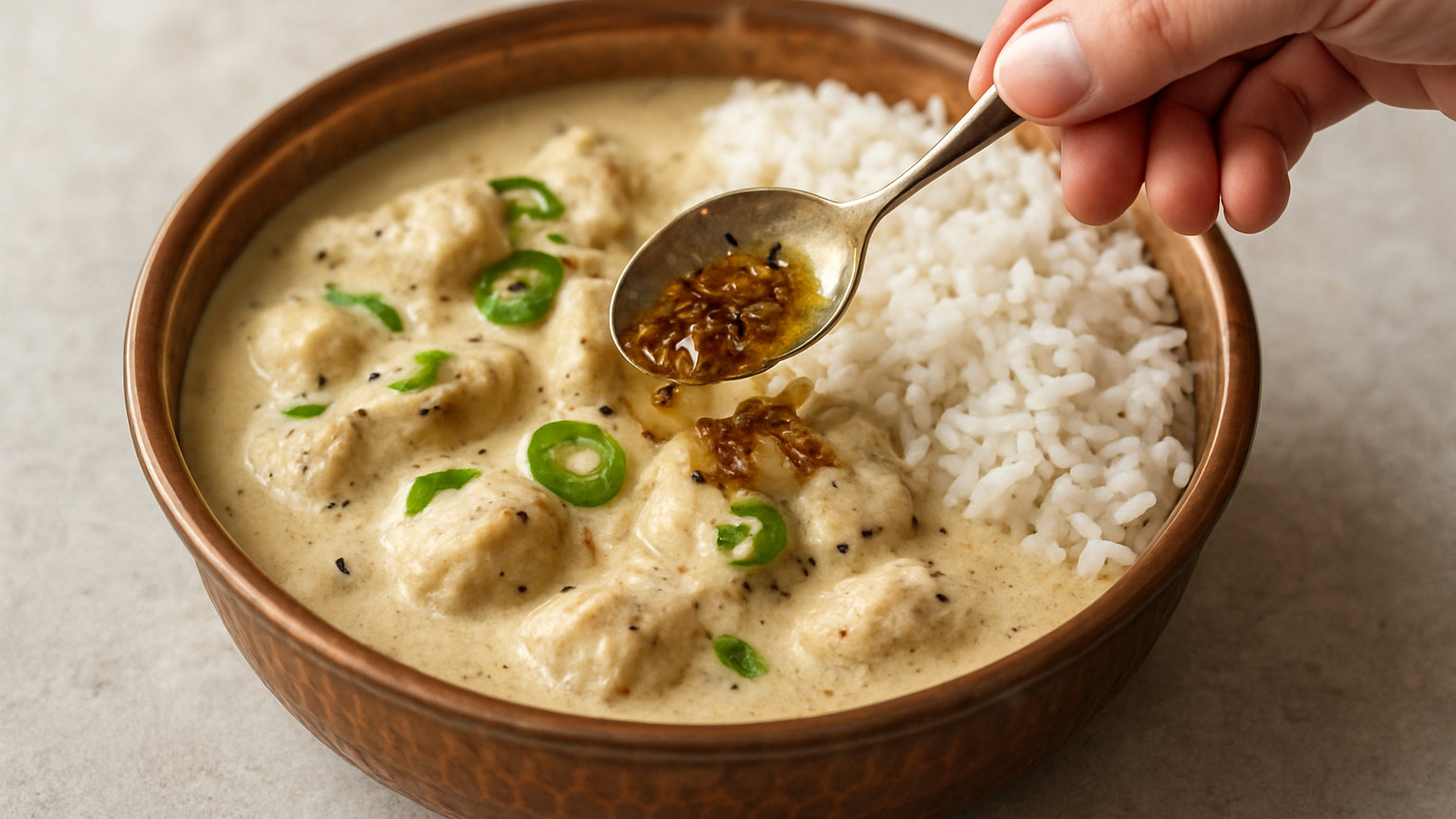
In a British curry house, korma sits at the bottom of the heat scale and is understood as the safe option. That is a local convention rather than a property of the dish. The word describes a braising technique, and plenty of traditional kormas are seriously spiced.
Where did the mild version come from?
From the practical logic of a menu. British curry houses, most established by Bangladeshi and Sylheti families from the middle of the twentieth century, organised their offerings along a single axis of heat so that customers unfamiliar with the food could order confidently. Korma took the bottom of the scale, madras the middle, vindaloo the top.
Because a korma is thickened with nuts and dairy and contains little chilli by default, it fitted that slot naturally. Sweetening it further with sugar and coconut widened its appeal, and within a generation the sweet mild version became what the word meant in English.
Which traditional kormas are hot?
- Kashmiri korma - often carries a substantial quantity of dried Kashmiri chilli, giving colour and a real if rounded heat.
- Hyderabadi korma - built with green chilli and black pepper, and frequently sharper than a madras.
- Pakistani white korma - pale in colour but heavily peppered, using white pepper and green chilli so the heat does not show.
- Shahi korma - the courtly version, rich rather than hot, and closest to the British idea.
The white korma is the most instructive case, because it looks exactly like the mildest thing on any menu and can be quietly ferocious.
How do you add heat without ruining the character?
Use green chilli and black or white pepper rather than red chilli powder. Red chilli stains the sauce orange and brings a blunt, front-loaded burn that fights the delicacy of the aromatics. Green chilli gives a brighter, sharper heat and leaves the colour alone, while pepper builds a slower warmth at the back of the palate that suits cream and nuts.
Two slit green chillies added with the onions and half a teaspoon of freshly ground black pepper at the end will transform a korma without making it look any different.
Does the dairy hide the heat?
It genuinely reduces it. Capsaicin is fat-soluble, and the fat in cream, yoghurt and ground nuts binds it and carries it away from the receptors on the tongue. That is the same reason a glass of milk works better than water against chilli burn.
The practical consequence is that a korma can carry noticeably more chilli than a tomato-based curry before it reads as hot, which is exactly how the peppery regional versions manage to be both rich and fierce.
Should a korma be sweet at all?
Faintly, and from its ingredients rather than from a spoon. Gently cooked onion, cashews and cream all contribute a natural sweetness, and that is meant to be there. Added sugar, and the desiccated coconut that many recipes call for, push it toward dessert territory.
If you have only eaten the sweetened version, a korma made without sugar tastes surprisingly savoury, and considerably more interesting.
Is the British version worth defending?
On its own terms, yes. It is a coherent dish that a great many people enjoy, and dismissing it as inauthentic misses that curry-house cooking is its own tradition with its own history rather than a degraded copy of something else. The point is simply that it represents one branch of a much wider family, and the other branches are worth knowing about.
What does the name tell you about the dish?
The root is a verb rather than a noun, which is the clue people miss. Related words appear across Turkish, Persian and Urdu cooking vocabulary, all describing a method of browning and then braising meat in a covered pot with a small amount of liquid. A dish is a korma because of how it was cooked, not because of how hot it is or what colour it turned out.
How should you order if you want a hotter one?
Ask rather than assume. Many curry houses will happily add fresh green chilli to a korma if you request it, and a few keep a more traditional version off the printed menu. Failing that, a passanda or a pasanda-style dish gives you the same nut-and-cream base with rather more scope for spicing, and a chilli pickle on the side achieves most of it at the table.


