
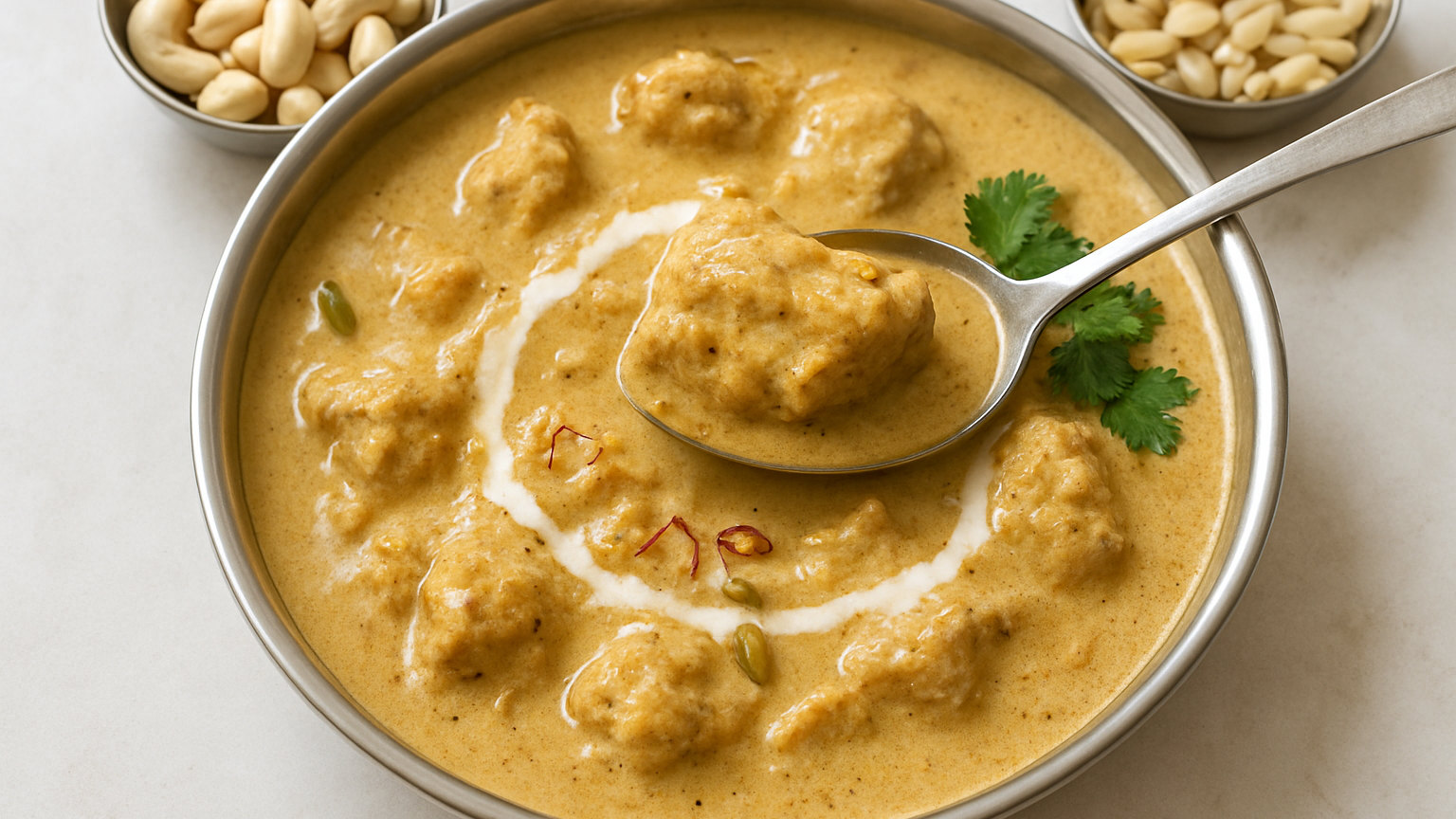
Cashews, almonds and melon seeds are the three traditional thickeners, and they are not interchangeable. Cashews give the smoothest and richest result, almonds give a slightly grainier sauce with more character, and melon seeds give the lightest of the three. Whichever you use, soaking is what determines the texture.
Why do cashews give the smoothest sauce?
Because they are soft, high in starch and low in fibre, so they break down completely under a blender into something closer to cream than to paste. They also carry a natural sweetness and a fatty richness that suits a korma without needing sugar added.
Soak them in hot water for twenty minutes and blend with a little fresh water until there is no grain left at all when you rub a drop between your fingers. Skipping the soak leaves a sandy texture that no amount of blending fixes.
What do almonds do differently?
Almonds are firmer and higher in fibre, so they never quite disappear the way cashews do. That gives a sauce with a slight body and a faint marzipan note, which many people prefer as it tastes more distinctly of something.
Blanched almonds are the right choice, since the skins would leave brown flecks through a pale sauce. Ready-ground almonds from a supermarket are perfectly usable and save a step, though they give less of a creamy texture than whole almonds soaked and blended fresh.
What are melon seeds and are they worth finding?
Charmagaz, sold in South Asian grocers as a blend of four seeds, is the older and arguably more authentic thickener in Mughal cooking. The seeds are mild, slightly sweet and produce a very light sauce without the heaviness of cashew.
They are worth trying if you cook korma often, though they are harder to source and give a subtler result that some find underwhelming after the richness of cashew.
What about poppy seeds and coconut?
White poppy seeds, known as khus khus, are a traditional thickener in several regional kormas and give an unusual nutty depth. They need a long soak and a powerful grinder, since they are tiny and stubborn.
Coconut is not traditional in a northern korma at all, though it appears in southern variations and heavily in the British curry-house version. Desiccated coconut in particular is what gives many takeaway kormas their distinctive sweet, slightly fibrous quality.
How much do you need?
- Cashews - 60 to 80g for four portions, soaked and blended.
- Whole blanched almonds - 70 to 90g, since they thicken slightly less per gram.
- Ready-ground almonds - 3 to 4 tablespoons, added directly without soaking.
- Melon seeds - 50 to 60g, soaked for at least half an hour.
Add them roughly two-thirds of the way through cooking. They need ten to fifteen minutes to swell and release their starch, and much longer than that in a hot pan can make the sauce claggy.
Does toasting them first help?
It changes the dish rather than improving it. Toasted nuts give a darker, deeper, more roasted flavour and a browner sauce, which suits a rustic version but works against the pale delicacy a classical korma is aiming for. Leave them raw for a traditional result.
Can you use nut butter instead?
Cashew butter works surprisingly well and saves the soaking entirely, at around two tablespoons for four portions. Check it contains nothing but nuts, since added sugar or palm oil will show. Peanut butter does not work, because peanut is far too assertive and pulls the dish toward a satay flavour that has no business in a korma.
Do nuts need to be fresh?
More than most cupboard ingredients. Nuts are high in fat, and fat goes rancid, which produces a stale, faintly bitter flavour that no amount of spice will hide. Cashews and almonds keep around six months in a sealed jar in a cool cupboard and considerably longer in the freezer, which is where a large bag belongs.
Smell them before use. Fresh nuts smell sweet and faintly milky, and rancid ones smell like old paint or cardboard.
Can you prepare the paste in advance?
Yes, and it is a useful thing to batch. Blended nut cream keeps three days in the fridge and freezes well in an ice cube tray, which turns a korma into a much quicker weeknight dish. Two frozen cubes is roughly one portion.


