
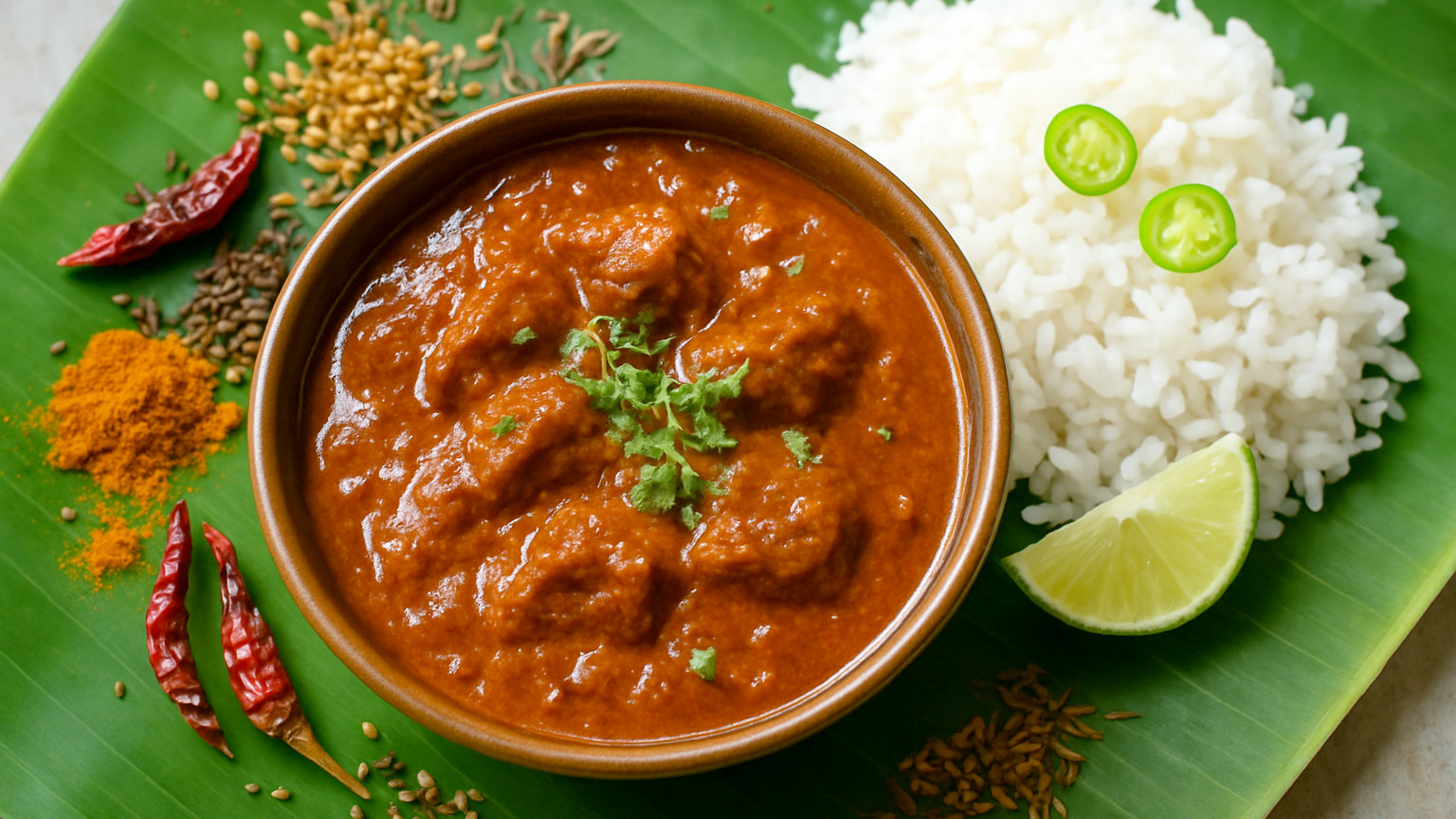
Madras curry powder is a commercial blend developed for the British market in the nineteenth century, distinguished from generic curry powder by being hotter, darker and containing fenugreek and mustard. It is a genuinely useful thing to have, and a homemade version is noticeably better than any jar.
How does it differ from ordinary curry powder?
Three ways. It carries considerably more chilli, so it is hot rather than merely warm. It contains fenugreek seed, which adds a bitter maple-like depth. And it usually includes mustard seed and black pepper, both of which push it toward southern Indian flavours.
Standard mild curry powder leans heavily on turmeric and coriander, which is why it produces a yellow, gentle result. Madras powder produces something darker and sharper.
Why is homemade better?
Because ground spices lose their aromatic oils within months, and a jar of blend sitting on a supermarket shelf has usually been ground long before you buy it. Whole spices keep their strength for years and release everything at the moment of grinding.
Toasting before grinding adds a second advantage, deepening the flavour and making the seeds brittle enough to grind cleanly.
Madras curry powder
Makes around 90g, enough for six or seven curries. Ten minutes of work.
Ingredients
- 4 tbsp coriander seeds
- 2 tbsp cumin seeds
- 1 tbsp black peppercorns
- 2 tsp black mustard seeds
- 1.5 tsp fenugreek seeds
- 1 tsp fennel seeds
- 6 dried Kashmiri chillies, broken and deseeded
- 2 dried hot chillies, or more to taste
- 20 fresh or dried curry leaves
- 1 small cinnamon stick and 4 cloves
- 2 tbsp ground turmeric, added after grinding
Method
- Heat a dry heavy frying pan over a medium-low heat.
- Add the coriander and cumin seeds and toast for 2 to 3 minutes, shaking the pan, until they darken slightly and smell strongly aromatic.
- Add the peppercorns, mustard seeds, fennel, cinnamon and cloves and toast for a further 90 seconds. The mustard seeds will begin to pop.
- Add the fenugreek seeds and toast for 45 seconds only. Fenugreek turns bitter very quickly and should barely colour.
- Add the broken chillies and curry leaves and toast for 30 seconds, keeping the pan moving. Do not let the chillies blacken.
- Tip everything onto a cold plate and spread it out. Cool completely, which takes around 10 minutes.
- Grind to a fine powder in a spice grinder or a heavy pestle and mortar, working in batches if necessary.
- Stir in the ground turmeric, which is not toasted because it burns readily and is almost always bought ready-ground.
- Store in an airtight jar away from light.
Why cool before grinding?
Because residual heat drives off exactly the volatile compounds you just developed, and grinding warm spice in an electric grinder makes it worse by adding friction heat. The mixture also clumps rather than powdering if there is any moisture left in it.
How long does it keep?
Three to four months at full strength, and it remains usable for six. That is shorter than a commercial jar claims, because a fresh blend has considerably more to lose. Make small batches often rather than one large one.
How much do you use?
Around two and a half to three tablespoons for four portions, in place of the individual ground spices in a madras recipe. Bloom it in hot fat for 40 seconds as you would any ground spice, and add chilli separately if you want more heat than the blend supplies.
Why is fenugreek toasted last?
Because it is by far the most fragile of the seeds here. Fenugreek carries a pleasant maple-like bitterness when barely toasted and turns harshly, unpleasantly bitter within thirty seconds of going too far. Adding it at the end of the toasting gives it the least exposure, and it should barely change colour.
Can you leave the chilli out?
Yes, and it is worth considering. A blend without chilli gives you the aromatic backbone and lets you add heat separately and precisely for each dish, which is more flexible than a fixed heat level baked into the jar. Store it as a base blend and keep Kashmiri and hot chilli powders alongside.
What can you use it for?
Beyond a madras, it works in a simple dal, rubbed onto a chicken before roasting, in a lentil soup, or stirred into a pan of fried potatoes. It is more useful than a generic curry powder because the fenugreek and mustard give it a distinct character rather than a vague one.


