
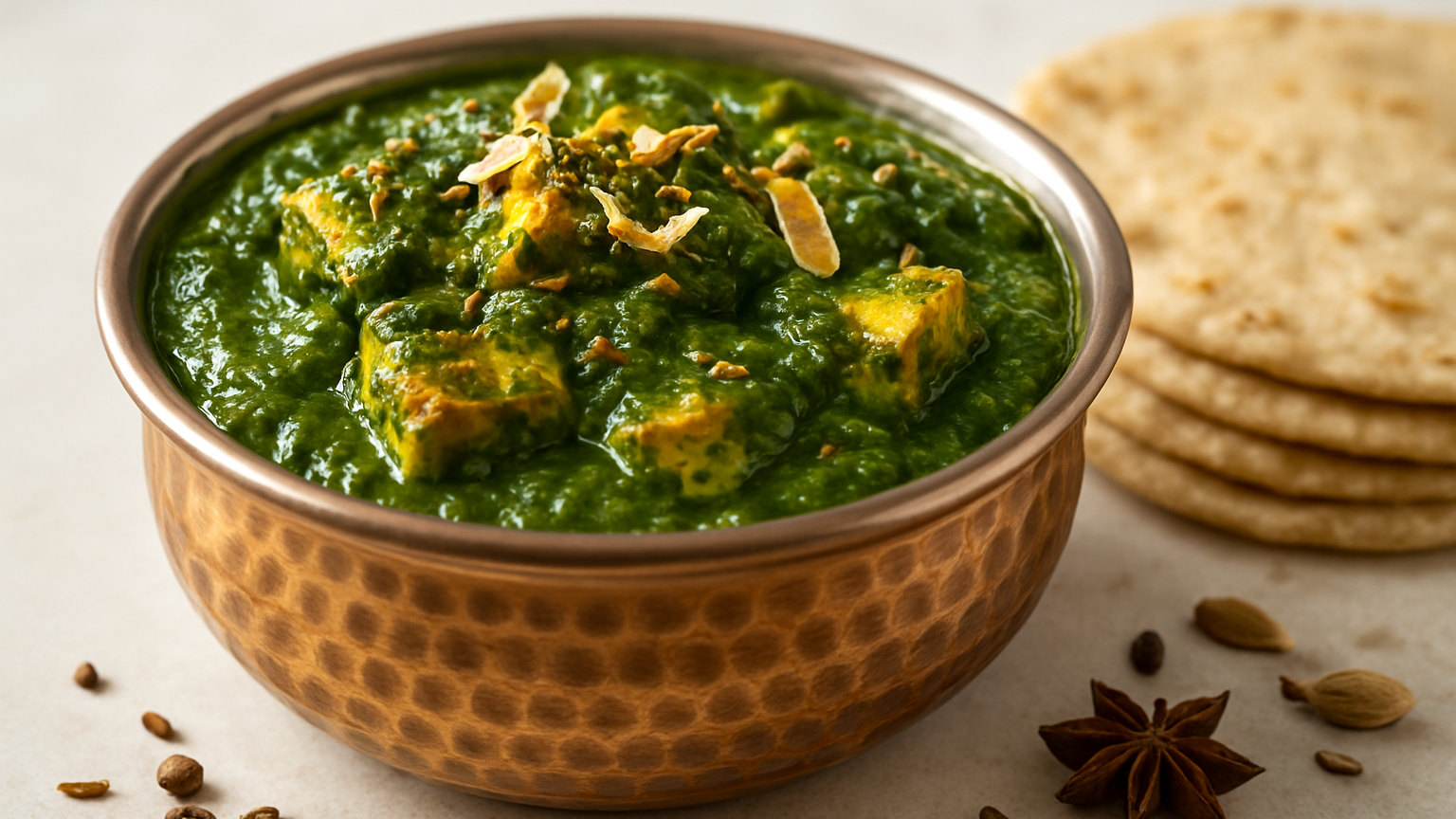
Most homemade saag paneer comes out a dull olive brown. The restaurant version is vivid green, and the difference is one technique: blanching the spinach briefly and dropping it into iced water, rather than wilting it slowly in the pan.
Why does spinach turn brown?
Because heat and acid break down chlorophyll. Held at temperature for more than a few minutes, the bright green magnesium-containing compound converts into a dull olive one, and the change is irreversible.
Blanching for ninety seconds cooks the spinach through before that conversion gets going, and plunging it into iced water stops the process dead. Blended immediately afterwards, the colour holds through the rest of the cooking.
Should the puree be smooth?
Partly. A completely smooth puree tastes uniform and slightly baby-food-like, while a coarse chop leaves stringy pieces. Blend most of it smooth and pulse a handful separately for texture, or simply stop blending while some texture remains.
Saag paneer
Serves four. Twenty minutes of preparation and thirty minutes of cooking.
Ingredients
- 500g spinach, washed, or 300g frozen leaf spinach
- 400g paneer, in 2.5cm cubes
- 4 tbsp ghee or vegetable oil
- 1 tsp cumin seeds
- 1 large onion, finely chopped
- 5 garlic cloves and 4cm ginger, crushed
- 2 green chillies, finely chopped
- 1 tsp ground coriander, half tsp ground cumin, half tsp turmeric
- 1 medium tomato, finely chopped
- 1 tsp salt
- 75ml double cream or 3 tbsp full-fat yoghurt
- Half tsp garam masala and a squeeze of lemon
Method
- Bring a large pan of water to a rolling boil and prepare a bowl of iced water alongside.
- Drop the spinach in for 90 seconds only, then lift it straight into the iced water. Leave for a minute.
- Squeeze the spinach hard to remove as much water as possible, then blend to a coarse puree with a splash of water. Set aside.
- Heat 2 tbsp of the ghee in a frying pan over a medium-high heat and fry the paneer for 2 minutes a side until golden on two or three faces. Remove and set aside.
- Add the remaining ghee to the pan and fry the cumin seeds for 30 seconds.
- Add the onion with a pinch of salt and cook for 12 minutes until soft and golden.
- Add the garlic, ginger and green chillies and cook for 2 minutes.
- Lower the heat, add the ground spices for 40 seconds, then the tomato and salt. Cook for 6 minutes until it breaks down.
- Add the spinach puree and cook for 5 minutes only, stirring. Do not cook it longer, since this is where the colour is lost.
- Stir in the cream, fold the paneer back in gently, and warm through for 2 minutes.
- Add the garam masala and lemon juice and serve immediately.
Is saag the same as palak?
Not quite. Palak means spinach specifically. Saag is a broader term covering leafy greens generally, and a traditional Punjabi saag often uses mustard greens, which are more bitter and more interesting. Most restaurant saag paneer is really palak paneer.
Does frozen spinach work?
Very well, and it is often better value. It has already been blanched, so skip that step entirely. Thaw it, squeeze it very hard indeed, and use it directly. Frozen leaf spinach is preferable to frozen chopped, which is usually wetter.
Why soak the paneer first?
Warm salted water for fifteen minutes softens the surface and adds moisture back into a block that has usually been pressed hard and refrigerated. It gives a noticeably softer interior after frying and buys a margin of error, since paneer turns rubbery quickly once its proteins tighten.
Can you make it vegan?
Yes. Use oil rather than ghee, pressed firm tofu instead of the paneer, and cashew cream or coconut cream in place of the dairy. Tofu needs slightly longer to brown, around three minutes a side, and a light dusting of cornflour helps it develop a crust.


