
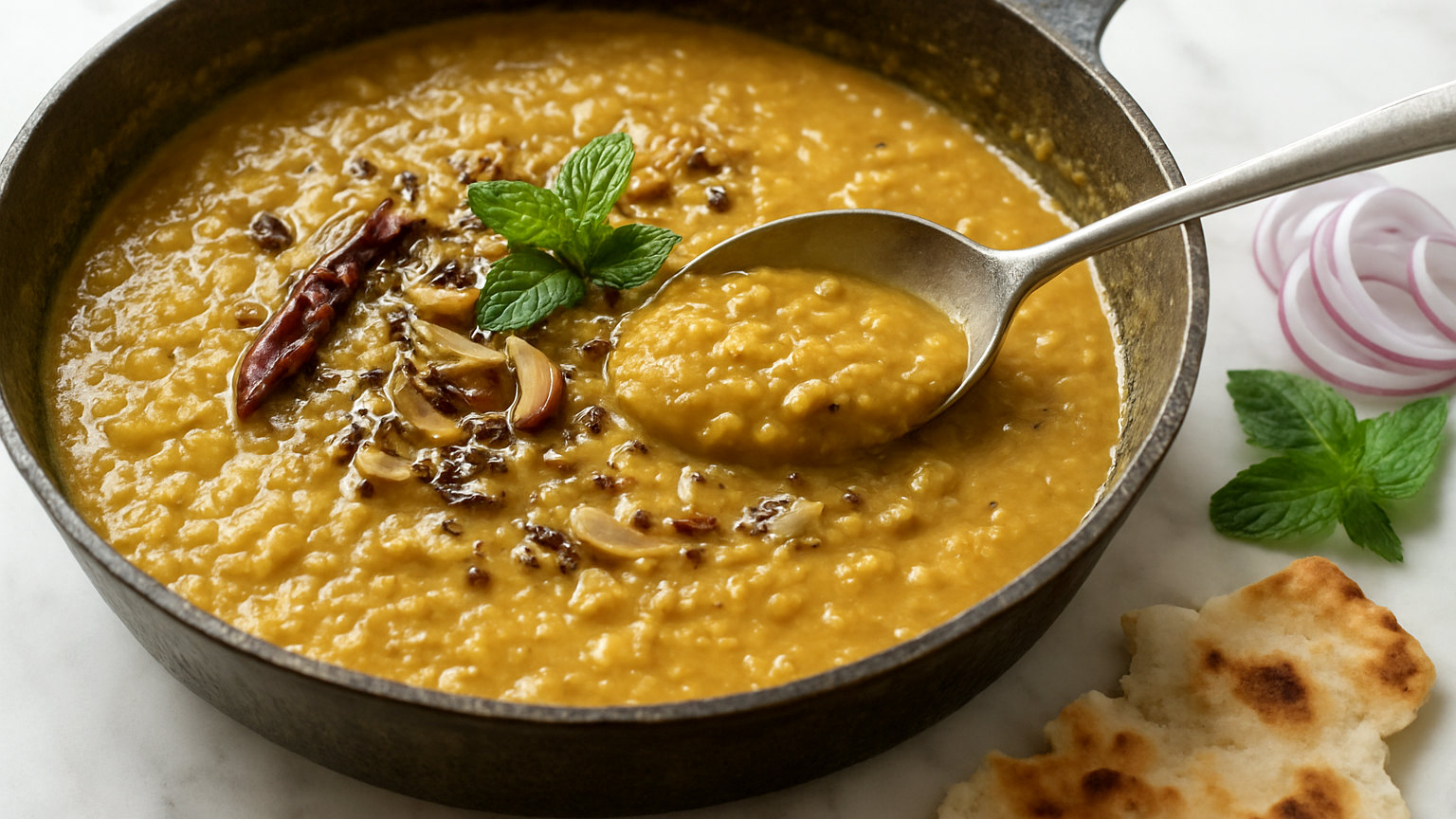
Dal confuses people because it looks like one dish and is actually two. The lentils are boiled almost plainly, with little more than turmeric and salt. Everything that makes it taste of anything happens in a separate small pan in the final thirty seconds, and gets poured over at the end.
Why cook it in two parts?
Because the two halves want opposite conditions. Lentils need long, gentle, wet cooking to break down into something creamy. Whole spices need brief, fierce, dry heat in fat to release their aromatic compounds.
Try to do both in one pot and you get neither. Spices boiled with lentils for thirty minutes taste dull and flat, having given up their volatiles into steam long before serving. That is why almost every disappointing homemade dal tastes like lentil soup.
What is the tarka?
The tempering. Hot ghee or oil, whole spices, garlic and dried chilli, cooked for well under a minute and poured over the finished lentils. It goes by several names across India, including tadka, chhonk and baghar, and the technique appears in a great many dishes beyond dal.
It should sizzle audibly when it hits the dal. That sound is the point, and if it does not sizzle the tarka was not hot enough.
Tarka dal
Serves four. Ten minutes of preparation and around forty minutes of cooking.
For the dal
- 250g red split lentils, known as masoor dal
- 900ml water
- 1 tsp ground turmeric
- 1 tsp salt, plus more to finish
- 3cm ginger, finely grated
- 1 fresh green chilli, slit
For the tarka
- 4 tbsp ghee, or vegetable oil for a vegan version
- 1.5 tsp cumin seeds
- 1 tsp black mustard seeds
- 6 garlic cloves, thinly sliced
- 2 dried red chillies, broken in half
- 12 fresh curry leaves
- 1 small onion, very finely sliced
- 1 tsp Kashmiri chilli powder
- A generous pinch of asafoetida, if you have it
- Juice of half a lemon and fresh coriander to finish
Method
- Rinse the lentils in several changes of cold water until it runs clear, which takes three or four rinses.
- Put them in a pan with the water, turmeric, salt, ginger and green chilli. Bring to the boil.
- Skim off the grey foam that rises in the first few minutes and discard it.
- Lower the heat and simmer uncovered for 25 to 30 minutes, stirring occasionally, until the lentils have collapsed completely and the mixture is thick and creamy.
- Whisk vigorously for a few seconds to smooth it out, and adjust the consistency with hot water if needed.
- Now make the tarka. Heat the ghee in a small frying pan over a medium-high heat until it shimmers.
- Add the cumin and mustard seeds and wait for them to crackle and pop, around 30 seconds.
- Add the sliced garlic, dried chillies and curry leaves and fry for 40 seconds until the garlic turns pale gold. Do not let it brown.
- Add the onion and fry for 3 minutes until softened and just golden.
- Take the pan off the heat, stir in the chilli powder and asafoetida, and immediately pour the whole thing over the dal. It should sizzle loudly.
- Stir once, add the lemon juice, check the salt and scatter with coriander.
How thick should it be?
Like a loose porridge, pourable but with body. It thickens considerably as it cools and again overnight, so err on the loose side and keep a kettle of hot water nearby to adjust it.
What is asafoetida for?
It is a dried resin with a pungent sulphurous smell raw that mellows into a savoury, almost onion-like depth once fried. A pinch adds a background note that is difficult to place and hard to do without once you are used to it. It also aids digestion of pulses, which is why it appears in so many lentil dishes.
Can you make it in advance?
The lentils yes, the tarka no. Boiled dal keeps four days in the fridge and freezes well, and it thickens considerably as it sits so it will need loosening with hot water. Make a fresh tarka each time you reheat it, which takes forty seconds and restores everything storage takes away.
Which lentils can you substitute?
Moong dal behaves almost identically and cooks in the same time. Toor dal needs around forty-five minutes rather than twenty-five and gives a slightly nuttier result. Chana dal is a different proposition entirely, holding its shape for an hour, and should not be swapped in without changing the method.


