
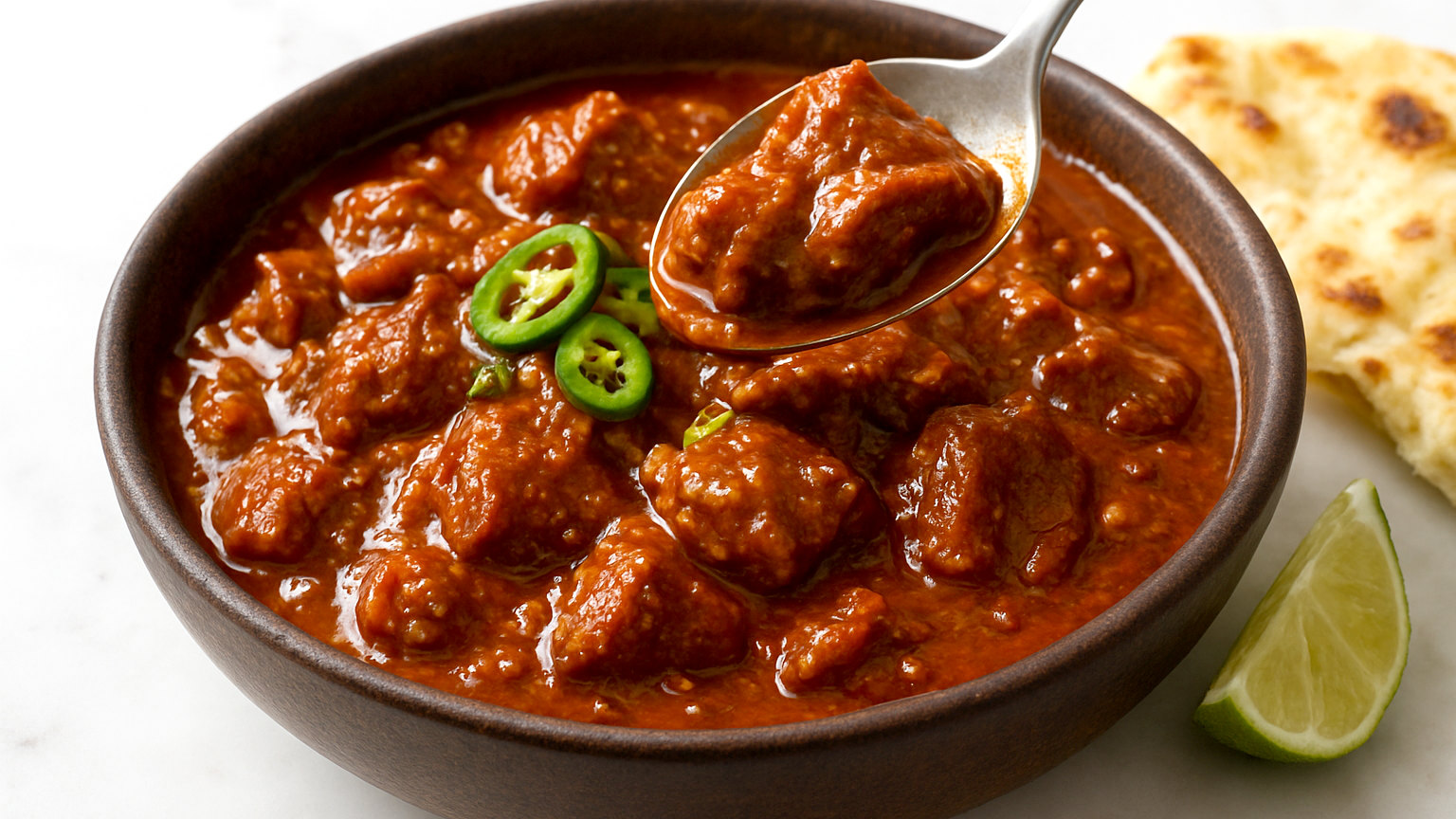
Lamb is the most common substitution for pork in a vindaloo outside Goa, largely because most British curry houses were run by families who did not cook pork. It works well, since lamb shoulder brings the fat and connective tissue the dish depends on.
Which cut and why?
Shoulder, boned and cut into 4cm chunks with the fat left on. It carries plenty of collagen, which converts to gelatine over a long cook and gives the sauce body, and the fat carries the chilli and softens the vinegar.
Leg is leaner and works but ends up drier. Neck fillet is excellent if you can get it. What will not work is any lean quick-cooking cut, since the dish needs the long braise for the acid and the spice to integrate.
How long does it need?
Around two hours of gentle covered simmering, plus fifteen minutes uncovered at the end to reduce. That is longer than a plain lamb curry needs, and the reason is the vinegar.
Acid tightens muscle proteins initially, so meat cooked in a strongly acidic sauce takes longer to become tender than the same cut cooked in a neutral one. Checking at ninety minutes and finding it tough is normal rather than a sign that something went wrong.
Lamb vindaloo
Serves six. Twenty minutes of preparation, overnight marinating, around two and a half hours of cooking.
Ingredients
- 1.2kg boneless lamb shoulder, in 4cm chunks
- 130g vindaloo paste, or the paste ingredients below
- 2.5 tsp salt
- 5 tbsp vegetable oil
- 3 large onions, finely sliced
- 2 tbsp tomato puree
- 300ml hot water or lamb stock
- 1 tbsp vinegar to finish
For the paste, if making fresh
- 12 dried Kashmiri chillies and 3 hot dried chillies, soaked 30 minutes
- 18 garlic cloves and 6cm ginger
- 2 tsp cumin seeds, 1 tsp peppercorns, 1 tsp cloves, a 5cm cinnamon stick
- 1 tsp turmeric, 1 tsp jaggery, 150ml cider vinegar
Method
- If making the paste, grind the toasted whole spices, then blend everything with the vinegar to a smooth thick paste using no water.
- Rub two thirds of the paste and the salt into the lamb, cover and refrigerate overnight.
- Heat the oil in a heavy casserole and cook the onions over a medium heat for 22 minutes until deep golden brown.
- Add the remaining paste and fry for 7 minutes, stirring constantly, until it darkens and the oil separates.
- Add the tomato puree and fry for 2 minutes.
- Add the lamb with all its marinade and cook for 10 minutes over a medium heat, turning it through.
- Add the hot water, bring to a simmer, cover and cook very gently for 2 hours, stirring every 25 minutes.
- Uncover and reduce for 15 minutes until the sauce is thick and glossy and the lamb yields to a spoon.
- Stir in the final vinegar, check the salt, and rest for 10 minutes before serving.
Can you use mutton or goat?
Both are excellent here and arguably better, with a stronger flavour that stands up to the paste. Add another forty-five minutes to the covered cooking, and judge by tenderness rather than by the clock.
Should the lamb be browned first?
Not in this case, which is unusual. The marinade coats every surface, and browning marinated meat scorches the paste rather than the meat. The depth comes instead from the long fry of the paste with the onions, which is why that stage should not be rushed.
Should it rest before eating?
A day, if you can manage it. Lamb vindaloo improves overnight more than almost any curry, as the vinegar mellows and the garlic turns sweet. Reheat gently, loosen with a splash of water, and add a fresh teaspoon of vinegar at the end to restore the brightness that storage costs it.
What about the fat on the surface?
Some of it belongs there, since it carries the chilli and gives the sauce its gloss. If more than a thin slick has gathered, particularly after refrigeration when it sets on top, skim the excess rather than stirring it back in. Lamb shoulder releases a good deal and not all of it is wanted.


