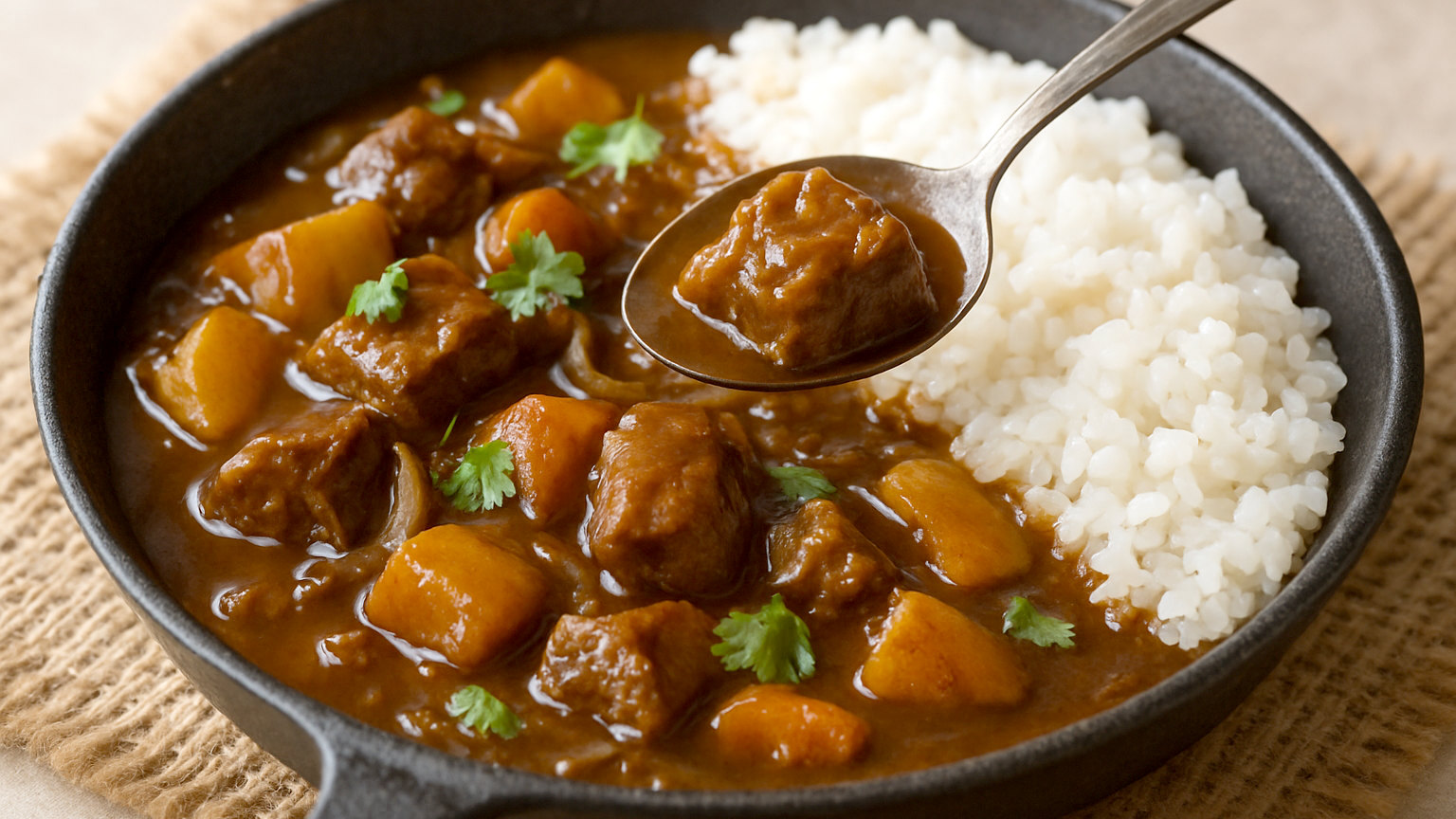
Japanese beef curry is the richest version of the heaviest curry tradition. Thickened with a flour roux rather than a paste, sweetened with fruit, and simmered until the beef falls apart, it sits closer to a beef stew than to anything cooked in India or Thailand.
What makes the beef version different?
The cooking time, and everything that follows from it. A chicken curry is done in forty minutes, where beef needs two hours for the collagen to convert into gelatine and give the sauce its body.
That long simmer also lets the sweetness settle, which is why beef curry is characteristically darker and more savoury than the chicken version.
How dark should the roux go?
Further than for a chicken curry. Ten to fifteen minutes over a low heat, until it is the colour of milk chocolate and smells distinctly nutty rather than merely biscuity.
A darker roux thickens slightly less per gram, so the quantity goes up marginally. What you gain is a depth that suits beef.
Japanese beef curry
Serves four to six. Twenty-five minutes of preparation and around two and a quarter hours of cooking.
Ingredients
- 900g beef shin or chuck, in 4cm chunks
- 2 tbsp vegetable oil
- 4 tbsp butter and 4 tbsp plain flour
- 2 tbsp Japanese curry powder
- 2 large onions, finely sliced
- 2 carrots, in thick chunks
- 3 garlic cloves and 3cm ginger, grated
- 1.2 litres beef stock
- 1 apple, grated
- 2 tbsp soy sauce, 1 tbsp honey, 1 tbsp tomato puree
- 1 tbsp Worcestershire sauce
- 500g waxy potatoes, in large chunks
- 1 tsp salt, adjusted at the end
Method
- Heat the oil in a heavy casserole and brown the beef hard in two or three batches. Set it aside and do not wash the pan.
- Add the butter to the same pan, let it melt, then stir in the flour. Cook over a low heat for 12 minutes, stirring constantly, until it reaches the colour of milk chocolate.
- Stir in the curry powder and cook for 1 minute more, then scrape the roux into a bowl.
- Soften the onions in the pan for 12 minutes without browning, then add the garlic and ginger for 2 minutes.
- Return the beef, add a third of the stock, and whisk in the roux a spoonful at a time until fully dissolved.
- Add the remaining stock gradually, then the apple, soy sauce, honey, tomato puree and Worcestershire sauce.
- Bring to a bare simmer, cover partly, and cook very gently for 90 minutes, stirring every 20 minutes.
- Add the carrots and potatoes and cook uncovered for a further 35 minutes, until everything is tender and the sauce has thickened around it.
- Check the salt and rest off the heat for 10 minutes before serving with short-grain rice.
Why brown the beef separately?
Browning leaves a residue on the base of the pan that the onions later dissolve, and that residue is concentrated savoury depth. The difference is more obvious here than in a spiced Indian dish where the masala is doing more work.
Why do the potatoes go in late?
They need thirty-five minutes and the beef needs ninety. Adding them together leaves dissolved potato clouding a sauce that still contains tough meat.
Does it need Worcestershire sauce?
It is standard in Japanese beef curry and does more than its quantity suggests, contributing acidity, salt, tamarind depth and a dark colour all at once. Given that the dish descends from Victorian British cooking, its presence is less surprising than it first appears.
If you have none, a tablespoon of soy sauce with a teaspoon of vinegar and a pinch of sugar covers most of what it does.
How thick should the finished sauce be?
Thick enough to coat the beef and hold its shape when spooned beside rice rather than running to the edge of the plate. Japanese curry is noticeably thicker than any Indian or Thai sauce, closer to a gravy, and it thickens further as it cools.
Can you make it a day ahead?
It is better for it, and this is worth planning around. The beef continues absorbing the sauce as it cools, the flavours integrate, and the fat sets on the surface overnight so it can be lifted off cleanly. Reheat gently, loosen with a splash of stock, and it tastes noticeably rounder than on the night.