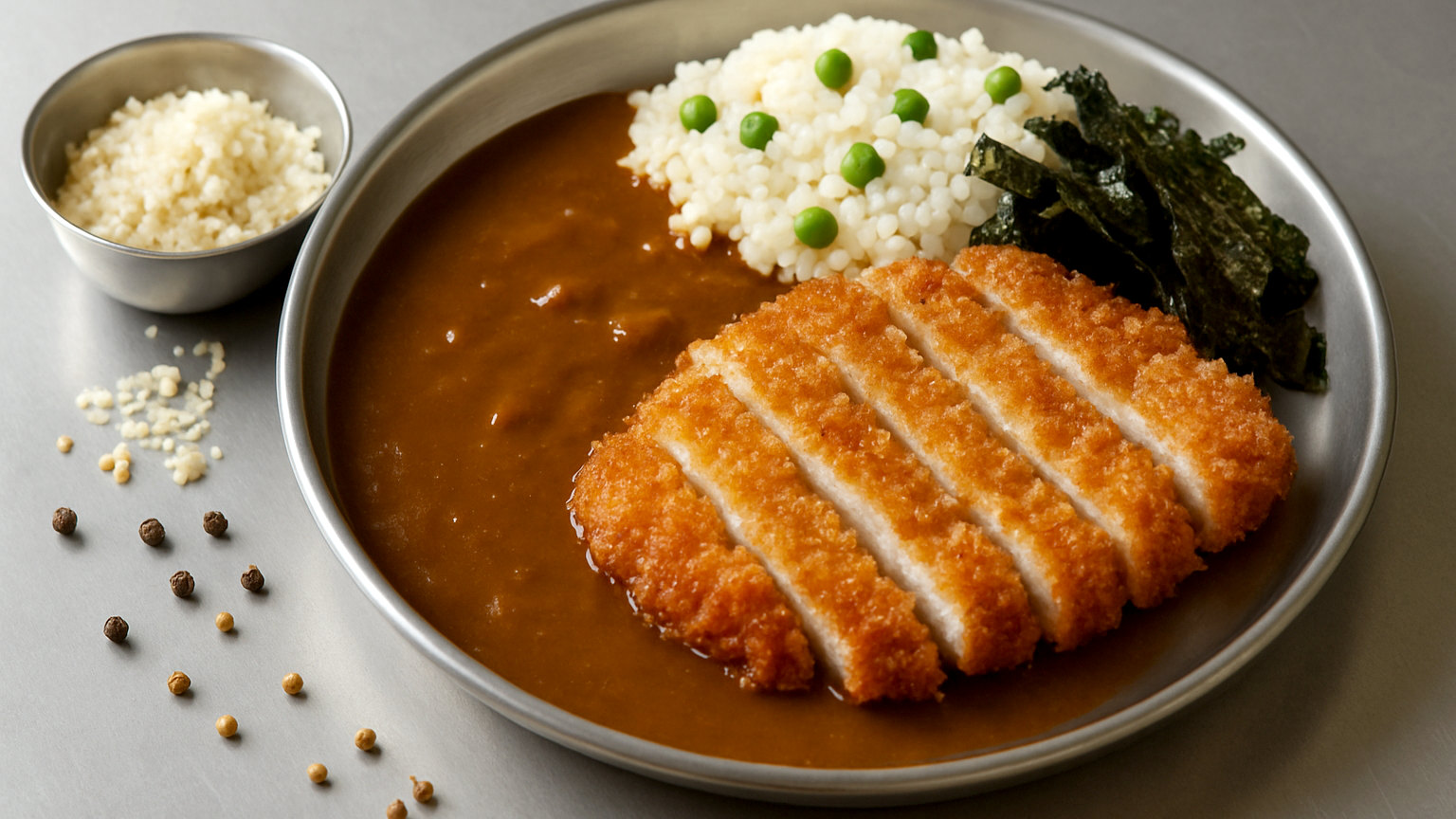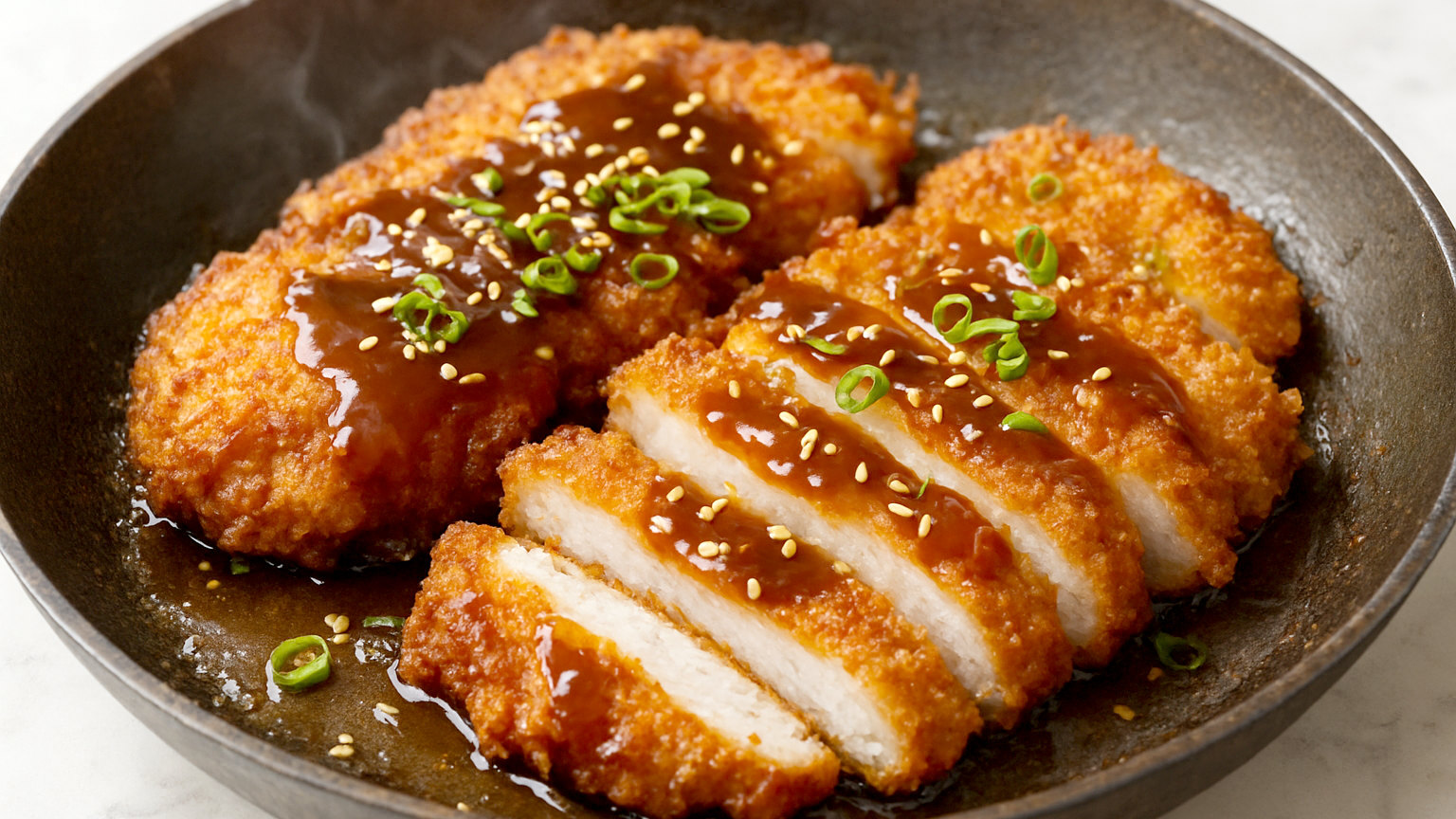
Chicken katsu for two is straightforward. For eight it becomes a scheduling problem, since the first cutlet is losing its crust while the fourth is still in the pan. The professional answer is to fry twice.
How does double frying work?
The first fry cooks the chicken through at a lower temperature without pushing the crust to its final colour. The cutlets then rest, sometimes for an hour or more. The second fry, brief and very hot, drives off surface moisture and crisps everything at once.
The result is arguably crisper than a single fry, because the resting period lets moisture migrate out of the crust before it is sealed a second time.
Chicken katsu for eight
Serves eight. Forty minutes of preparation, a first fry up to two hours ahead, and eight minutes at the end.
Ingredients
- 8 chicken breasts, butterflied and beaten to 1.5cm
- Salt and white pepper
- 120g plain flour, 4 eggs beaten with 2 tsp water, 250g panko
- Vegetable oil for frying, 4cm depth
- Curry sauce and short-grain rice to serve
Method
- Butterfly, beat and season all the chicken, then bread every piece and rest them on racks in the fridge for at least 20 minutes.
- Heat the oil to 160C, which is lower than usual.
- Fry two cutlets at a time for 3 minutes a side, until cooked through but only lightly coloured. Check one reaches 72C.
- Drain on wire racks, spaced apart, and leave at room temperature for up to 2 hours. Do not stack them.
- Make the sauce and cook the rice during this window.
- Twenty minutes before serving, bring the oil up to 190C.
- Fry the cutlets in batches of three for 45 to 60 seconds only, until deep golden and crisp.
- Drain briefly on racks, slice, and plate immediately.
Why not just keep them warm in the oven?
A low oven works for around twenty minutes on a wire rack at 120C, and beyond that the chicken continues cooking and dries out while the crust slowly softens. It is a holding measure rather than a solution.
If you use it, keep the oven door slightly ajar so steam escapes, and never cover the cutlets with foil.
Can the first fry be done a day ahead?
It can, refrigerated on racks and uncovered, though the crust is noticeably better on the same day. Bring them back to room temperature for thirty minutes before the second fry, or the centre will still be cold when the crust is done.
How much oil do you need?
Around two litres in a wide heavy pan for this quantity, which sounds excessive and is what keeps the temperature stable. A large volume of oil recovers far faster after cold cutlets go in, and stable temperature is the whole point of the exercise.
Strain it while warm afterwards and it can be used two or three more times.
What about the rice and sauce?
Both hold far better than the cutlets. Sauce keeps warm on a low hob for an hour and improves slightly. Rice holds covered off the heat for twenty minutes and can be made in two batches if your pan is small. Neither needs to be timed to the second fry.
Can you do it in an air fryer?
The capacity is usually the problem rather than the technique. Most domestic air fryers hold two cutlets in a single layer, which means four batches for eight people and the same holding problem you started with. The oil route scales better for numbers.
How far ahead can the first fry be?
Two hours at room temperature is comfortable, and longer than that the chicken should go in the fridge for safety. If refrigerated, bring the cutlets back to room temperature for thirty minutes before the second fry, or the centre will still be cold when the crust is done.
Does it work for pork too?
Identically, and tonkatsu is where the technique came from. Pork is slightly more forgiving in the holding period since it carries more fat, so a batch of pork cutlets tolerates a longer gap between the two fries than chicken breast does.