Chicken has to be cooked through, and a breadcrumb coating hides everything underneath it. That combination makes katsu one of the dishes where a thermometer earns its cost quickly.
What temperature?
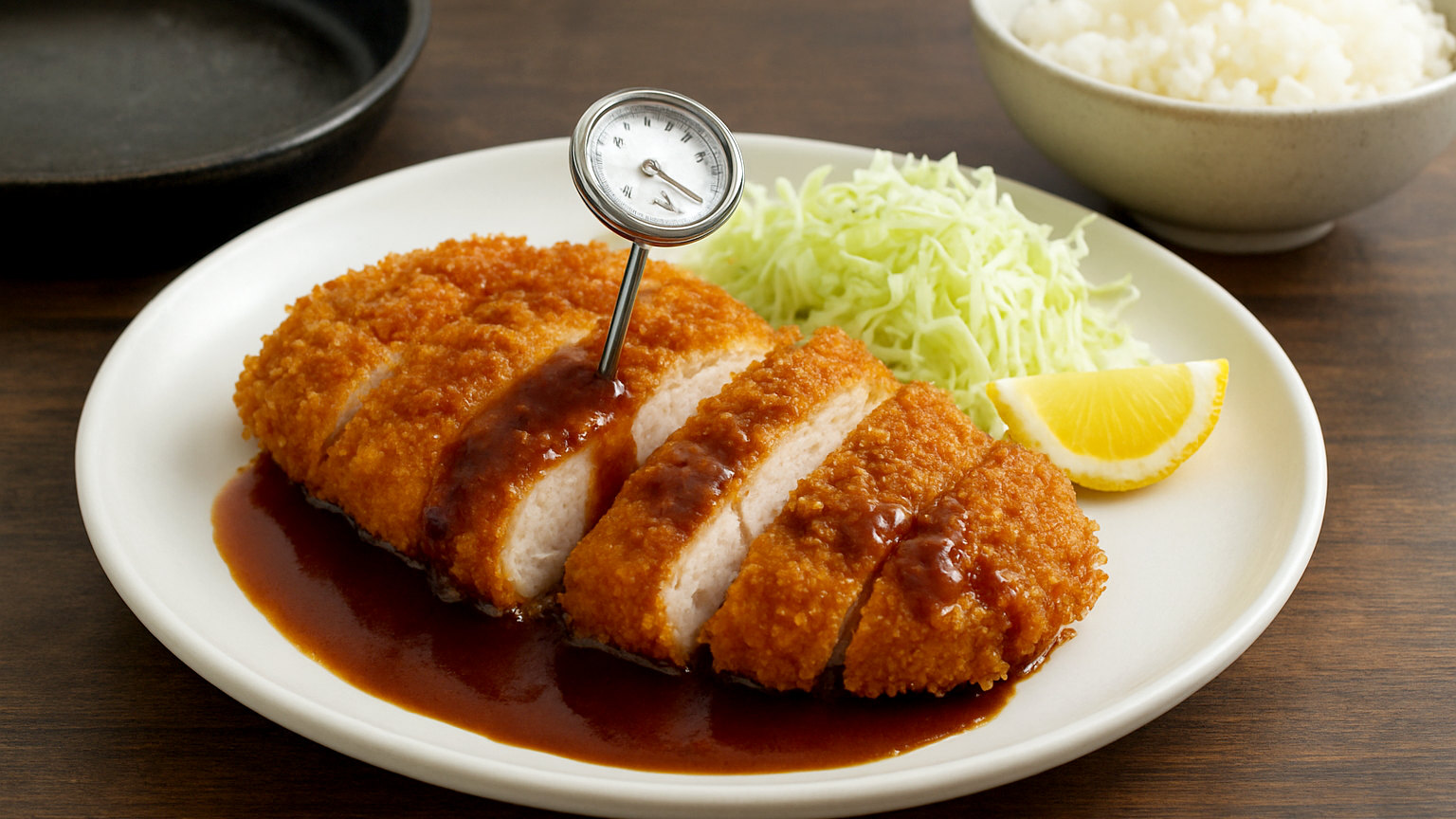
74C in the thickest part is the standard figure for chicken and it is what to aim for. Insert the probe through the side of the cutlet rather than the top, which avoids leaving a visible hole in the crust and reaches the centre more reliably.
Thigh benefits from a slightly higher figure, around 75C to 78C, since the connective tissue is more pleasant once it has begun to soften.
Is crust colour reliable?
Reasonably, provided the two other variables are right. At an even 1.5cm thickness and a steady 170C, a deep golden crust corresponds closely to a cooked centre, because the timings were matched deliberately.
It stops being reliable the moment either variable slips. A thicker cutlet or hotter oil gives you a golden crust over raw chicken, which is exactly the situation that catches people out.
What are the other checks?
- Cut the thickest piece in half - the flesh should be opaque and white throughout with no translucent or pink area.
- Juices run clear - a rough guide rather than a certainty, since colour varies.
- Firmness - cooked chicken springs back when pressed where raw chicken stays indented.
- Floating - a cutlet tends to sit higher in the oil as it cooks and moisture leaves.
Cutting into one piece to check is entirely reasonable when cooking a batch. Use it as the cook portion.
Does it keep cooking after it comes out?
Yes, and this is worth building into the timing. A cutlet lifted from the oil at 71C will typically reach 74C or above during a two-minute rest, as heat from the crust moves inward.
That means you can pull it a shade early rather than pushing it to temperature in the pan, which is a useful margin with a cut that dries so readily.
What if it is undercooked?
Return it to the oil for a minute at a slightly lower temperature, around 160C, so the crust does not darken further while the centre catches up. An oven at 180C for five minutes on a rack works too and is gentler on the crust.
What you should not do is microwave it, which steams the coating into mush.
Is pink chicken always unsafe?
Colour is an unreliable indicator on its own. Meat close to a bone can stay slightly pink at a safe temperature, and myoglobin can hold colour under certain conditions. Temperature is the measure that matters, which is the argument for a thermometer.
In a boneless butterflied cutlet, pink almost certainly does mean undercooked.
Where should you probe?
Through the side, horizontally into the thickest part, stopping at the middle. Probing from above risks going straight through into the hot oil or the pan and giving a falsely high reading, and it leaves a hole that steam escapes through.
Should you check every piece?
Not necessary once you have established the timings for your pan and your thickness. Check the first one of a batch, and the largest piece if they vary. After that the crust colour and the clock are reliable, provided nothing about the setup has changed.
Does thickness change the target?
The target temperature stays at 74C regardless. What changes is how long it takes to get there and how much carryover cooking happens afterwards. A thicker cutlet carries over more, so it can be pulled further below target than a thin one.
Does the coating affect the reading?
It insulates, which means the surface of the meat under the crust is cooler than it would be on a bare cutlet. That is part of why crumbed chicken is forgiving. Probe into the centre rather than just under the crust, or you will get a reading several degrees below the truth.
What about frozen cutlets?
Timings become considerably less predictable, so a thermometer stops being optional. Cooking from frozen at 165C takes five to six minutes a side, and the variation between pieces is wider than with fresh chicken. Check every one of the first batch until you know your oven or pan.