Getting the ratio right is most of what makes a good curry udon, and it is the part recipes tend to gloss over because leftover curry varies so much in thickness.
What is the starting point?
Roughly equal volumes, so 350g of leftover curry to 400ml of dashi for two portions. That suits a curry of standard thickness straight from the fridge.
Add three quarters of the dashi first, whisk it in, then judge. It is far easier to add more than to remove it.
What consistency are you aiming for?
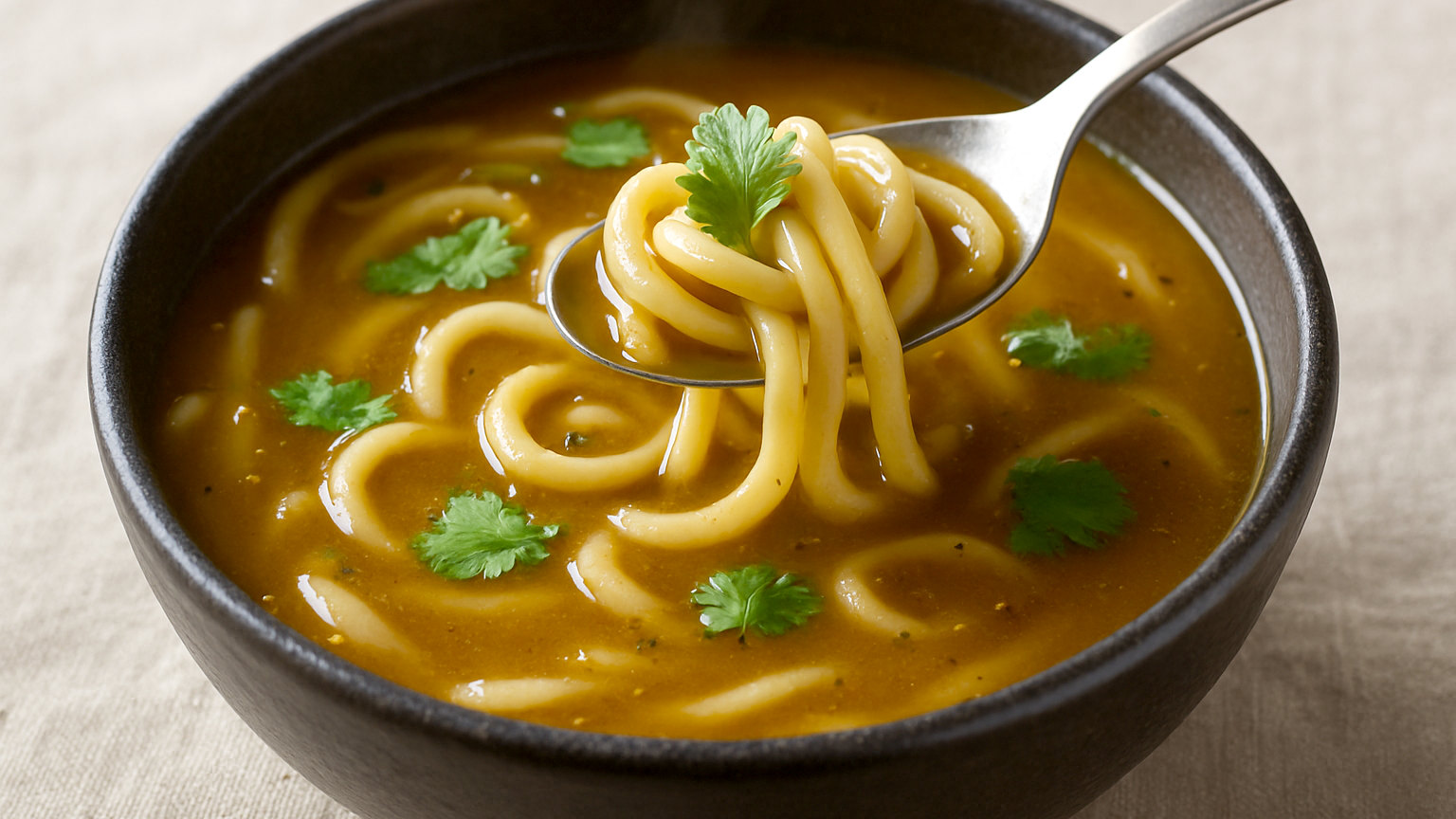
Something you could drink from the bowl, which is the useful test. It should coat the back of a spoon lightly rather than clinging to it, and it should flow readily when the bowl is tilted.
Thicker than that and it clags around the noodles rather than coating them. Thinner and it tastes washed out and slides off entirely.
Does the original curry matter?
- A thick beef curry - takes more dashi, perhaps 1.3 parts to 1.
- A standard chicken curry - roughly equal parts.
- A vegetable curry - slightly less, since it is usually looser.
- Curry set solid in the fridge - more again, and whisk hard to break it up.
- Curry made with extra water - less, and it may need thickening instead.
How do you reseason it?
Two tablespoons of soy sauce and one and a half of mirin per 400ml of dashi is the standard correction. Adding that much liquid dilutes everything, so the seasoning has to go back in.
Taste and aim for slightly stronger than you want, since the noodles carry water on their surface and dilute the broth further once they arrive.
What if it goes too thin?
Potato starch, sold as katakuriko, mixed with twice its volume of cold water and stirred into the simmering broth. A teaspoon for two portions thickens it noticeably within a minute and gives a glossy finish.
Cornflour works and gives a slightly duller result. Never add either dry, since it will lump instantly.
Can you use water instead of dashi?
You can, and the dish loses most of what makes it worth doing. Water dilutes without adding anything, so the result tastes like weakened curry rather than a broth in its own right.
If you have no dashi, instant dashi powder takes seconds and is what most Japanese households use. Failing that, a light chicken stock with a piece of kombu in it gets partway there.
Should the pieces stay in?
Large chunks of meat and vegetable are awkward to eat with chopsticks alongside noodles. Either break them up as you whisk, or lift them out first, thin the sauce, then return them cut smaller.
Some cooks strain the sauce entirely for a smooth broth and add fresh toppings instead, which makes a cleaner-looking bowl.
Should you heat the curry first?
Add it cold to warm dashi and whisk as it loosens, which breaks it up more evenly than trying to combine two hot liquids. Curry straight from the fridge is often solid, and whisking it into warming dashi over a low heat dissolves it without lumps.
Does the dashi need to be strong?
Standard strength is right. A very strong dashi competes with the curry rather than supporting it, and a weak one might as well be water. If you are using instant powder, follow the packet quantity rather than doubling it in pursuit of more flavour.
Does the fat content affect it?
A pork belly or beef curry carries a good deal of fat, which will have set on the surface in the fridge. Lift most of it off before thinning, since fat that was pleasant in a thick sauce reads as greasy in a broth where it separates and floats. Leave a little for gloss.
How do you judge it before serving?
Taste it from a spoon and then imagine it a shade weaker, since the noodles carry water on their surface and will dilute it further in the bowl. A broth that tastes exactly right in the pan will taste slightly flat once the udon arrive.