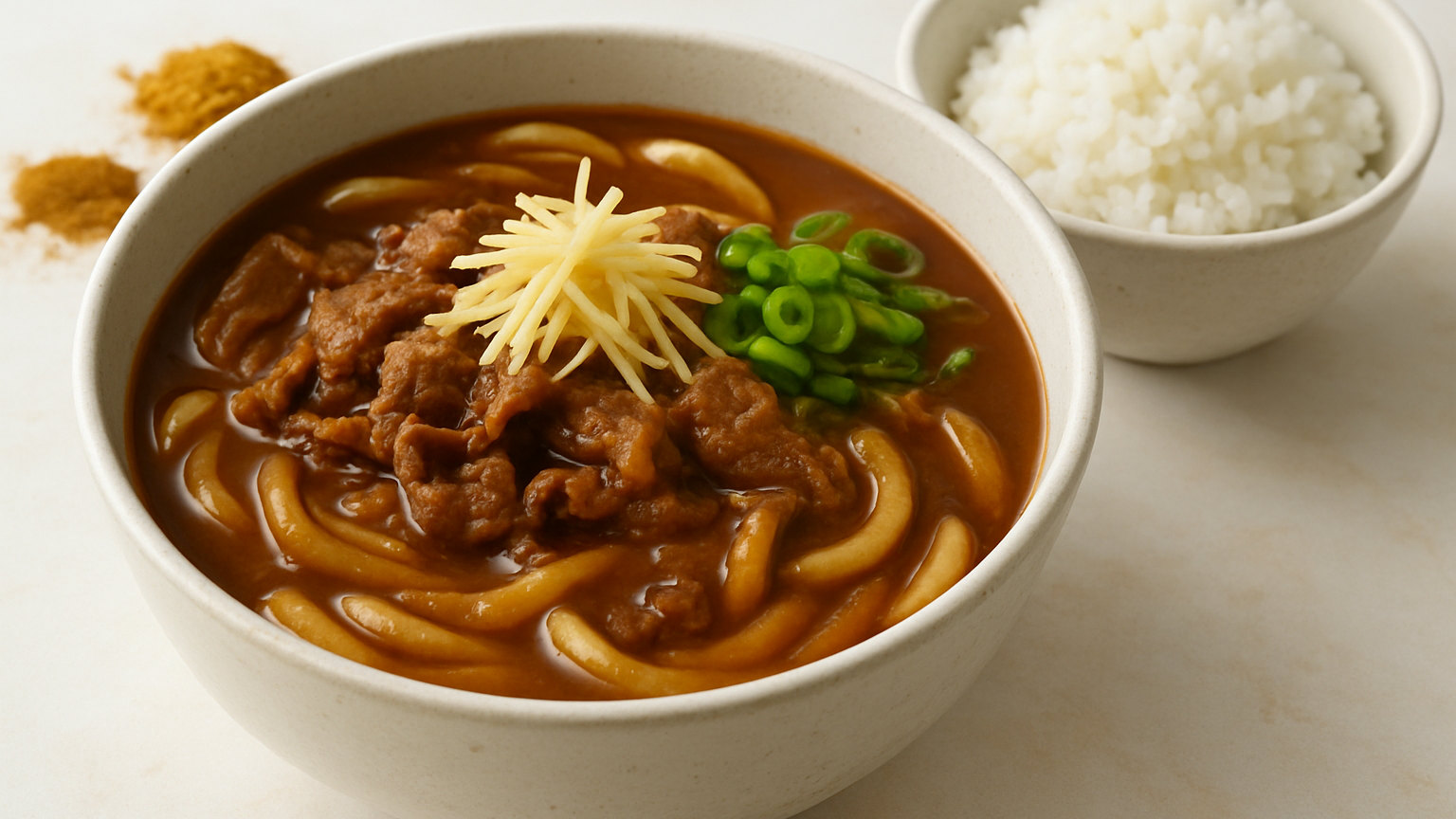
Curry udon is usually finished with a potato starch slurry in addition to whatever roux is in it, and the two are doing different jobs rather than duplicating each other.
What does each contribute?
The roux thickens and adds the toasted nutty depth that makes the broth taste like Japanese curry. Starch adds gloss, a silkier body and a clinging quality, without adding any flavour of its own.
Thickening entirely with roux would mean so much flour that the broth tasted pasty. Thickening entirely with starch would give gloss with none of the depth.
Why does clinging matter here?
Because udon are thick and slippery, and a thin broth slides straight off them into the bottom of the bowl. A lightly thickened broth coats each noodle so it arrives carrying flavour.
It also reduces splashing considerably, which is a real consideration with a bright yellow broth and a dish notorious for staining clothes.
What is katakuriko?
Japanese potato starch, sold in bags in any Asian grocer. It thickens at a lower temperature than cornflour, produces a clearer and glossier result, and gives a slightly more slippery texture that suits Japanese cooking.
Originally it was made from dogtooth violet root, which is what the name refers to, and almost all of it is now potato.
How do you use it?
- Mix one part starch with two parts cold water, never hot, and stir until smooth.
- Have the broth at a gentle simmer rather than a boil.
- Stir the broth, then pour the slurry in slowly while stirring.
- Simmer for one minute until it thickens and turns glossy.
- Stop there, since prolonged boiling breaks the starch down and it thins again.
How much for two portions?
A teaspoon of starch to two teaspoons of water, which is enough for around 700ml of broth. It is easy to overdo, and a broth that has gone gluey cannot be rescued except by adding more dashi.
Add half, judge, and add the rest only if needed.
Is cornflour a substitute?
It works and is not identical. Cornflour needs a higher temperature to activate, produces a slightly cloudier and duller result, and gives a softer, less slippery texture. Use around a quarter more than the potato starch quantity.
For a curry broth already coloured by turmeric, the visual difference matters less than it would in a clear soup.
Does it hold?
Starch-thickened broth thins again if held hot for a long period or reheated repeatedly, since the starch chains break down. Add the slurry at the end, serve promptly, and re-thicken with a fresh slurry if you are reheating leftovers.
Does it work with a block-based broth?
Yes, and it is arguably more useful there. A roux block dissolved into dashi produces a broth that can be thin and slightly slack, and a starch slurry gives it the gloss and body it lacks. The same teaspoon per 700ml applies.
Can you thicken it in advance?
Better not to. Starch-thickened broth thins again if held hot for long or reheated, since the starch chains break down. Add the slurry in the last minute before serving, and if you are reheating leftovers, thicken again with a fresh slurry rather than expecting the first to hold.
Does it change the mouthfeel?
Noticeably. A starch-thickened broth is slippery and glossy in a way a flour-thickened one is not, and that slipperiness is characteristic of Japanese noodle broths generally. Flour gives a softer, more opaque body. Having both is what makes curry udon feel different from either a curry sauce or a plain noodle soup.
Can you use flour instead?
A flour slurry works and gives a duller, cloudier result with a faintly raw taste, since flour needs cooking out and a slurry added at the end does not get it. Starch activates immediately and contributes no flavour, which is exactly why it is used at this stage rather than more roux.