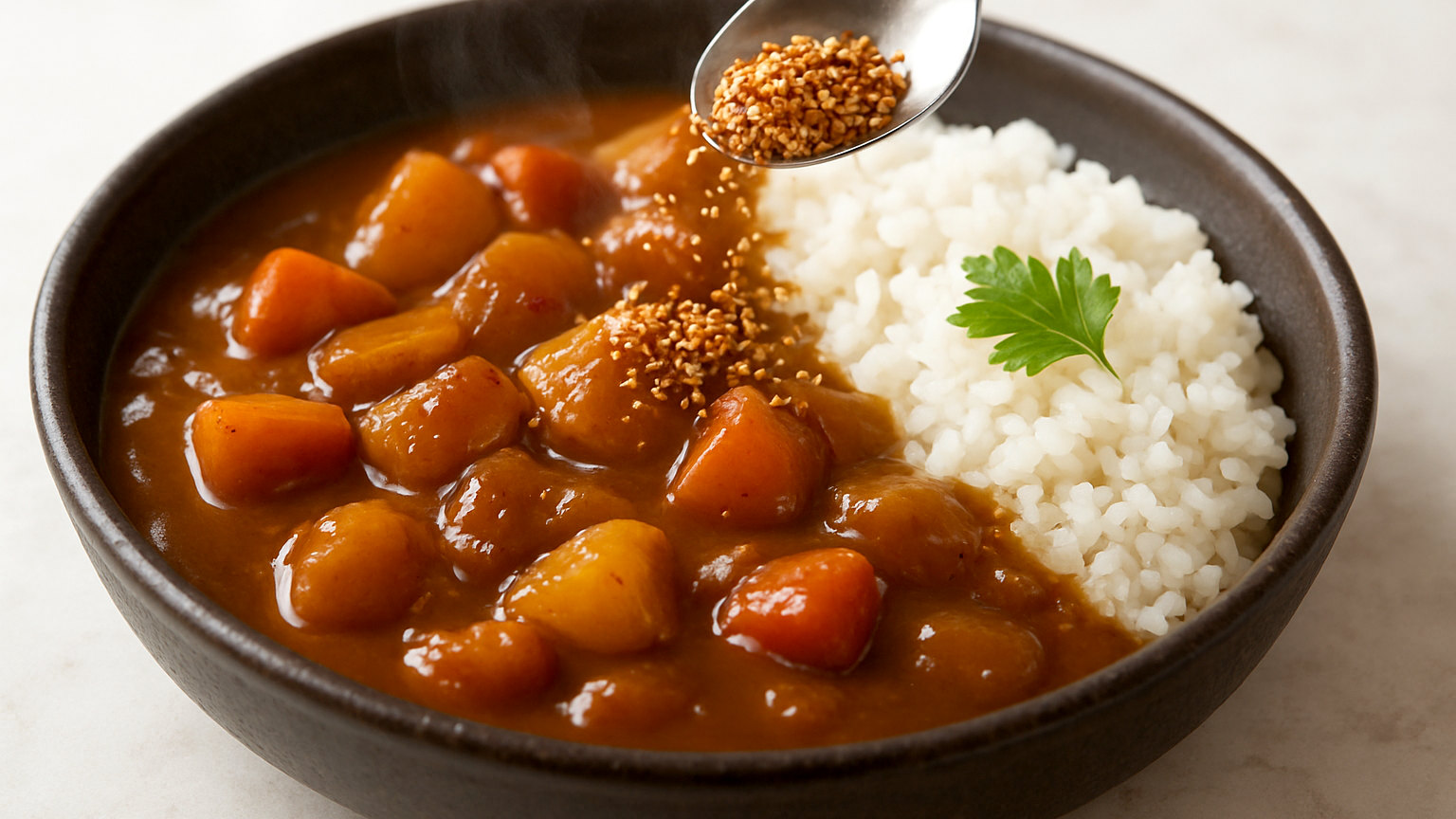
A Japanese curry sauce is thicker than any Indian or Thai equivalent, which changes what happens to vegetables in it. They sit suspended rather than floating, they cook more slowly because the sauce transfers heat less efficiently than thin liquid, and anything that breaks down clouds the sauce permanently.
What does the thickness change?
Two things. Vegetables take noticeably longer to soften in a flour-thickened sauce than in stock, because a thick liquid conducts heat less readily and there is less convection moving hot liquid around the pieces.
And anything that disintegrates cannot be strained out. In a thin curry a collapsed courgette disappears. In this one it turns the sauce grainy and stays that way.
Which vegetables suit it?
The dense ones that hold together. Kabocha squash, sweet potato, waxy potato, carrot, aubergine and firm mushrooms all work. Courgette, broccoli and anything leafy do not, and are better added at the very end or left out.
Japanese vegetable curry
Serves four. Twenty minutes of preparation and forty-five minutes of cooking.
Ingredients
- 400g kabocha squash or butternut, in 4cm chunks
- 300g sweet potato, in 4cm chunks
- 2 carrots, cut in rolling wedges
- 1 aubergine, in 3cm chunks
- 200g chestnut mushrooms, halved
- 4 tbsp vegetable oil, divided
- 3 tbsp butter and 3 tbsp plain flour
- 1.5 tbsp Japanese curry powder
- 2 onions, sliced
- 3 garlic cloves and 3cm ginger, grated
- 25g dried shiitake, soaked in 900ml hot water for 30 minutes
- 1 apple, grated
- 2 tbsp soy sauce, 1 tbsp mirin, 1 tbsp tomato puree
- 1 tsp yeast extract or 2 tsp white miso
Method
- Soak the dried shiitake in the hot water for 30 minutes. Lift them out, slice them, and strain the liquid to remove grit. Reserve both.
- Heat 2 tbsp of oil in a wide pan and fry the aubergine hard for 6 minutes until browned. Remove and set aside.
- Fry the fresh mushrooms in the same pan for 5 minutes until they have released their water and it has evaporated. Set aside with the aubergine.
- Melt the butter in the pan, stir in the flour and cook over a low heat for 6 minutes until pale gold. Add the curry powder for a minute, then scrape the roux out.
- Add the remaining oil and soften the onions for 12 minutes, then the garlic, ginger and sliced shiitake for 3 minutes.
- Add a third of the shiitake liquid and whisk in the roux a spoonful at a time, then the rest gradually.
- Add the apple, soy sauce, mirin, tomato puree and yeast extract.
- Add the carrots and simmer for 10 minutes, then the squash and sweet potato for 18 minutes.
- Fold in the reserved aubergine and mushrooms and cook for 5 minutes.
- Check the salt and rest for 5 minutes before serving with short-grain rice.
Why fry the aubergine separately?
Because it releases a great deal of water and absorbs a great deal of oil, and doing both in the sauce thins it and makes it greasy. Frying it first drives the water off and browns the surfaces, and it then holds its shape when folded back in.
Why the shiitake soaking liquid?
It is the single most useful thing in a meat-free Japanese curry. The liquid carries a savoury depth that vegetable stock does not, and it costs nothing beyond thirty minutes of soaking. Strain it, since dried mushrooms carry grit.
Does it need a protein?
Not really, since five vegetables and mushrooms make a substantial plate on their own. If you want one, fried tofu folded in at the end keeps its crust, and deep-fried tofu puffs sold as aburaage absorb the sauce well and are a genuinely Japanese option.
Should the roux be darker than usual?
Yes, and it is one of the specific adjustments a vegetable version needs. A pale roux disappears behind vegetables that are themselves mild, where one taken toward pale caramel supplies depth the meat would otherwise have provided. Nine or ten minutes rather than five.
Can it be made ahead?
The sauce yes, and the finished curry less happily than a meat version. Vegetables continue softening in storage and the squash in particular goes grainy by the second day. Make the sauce in advance, refrigerate it for up to four days, and add freshly cooked vegetables when you reheat.