
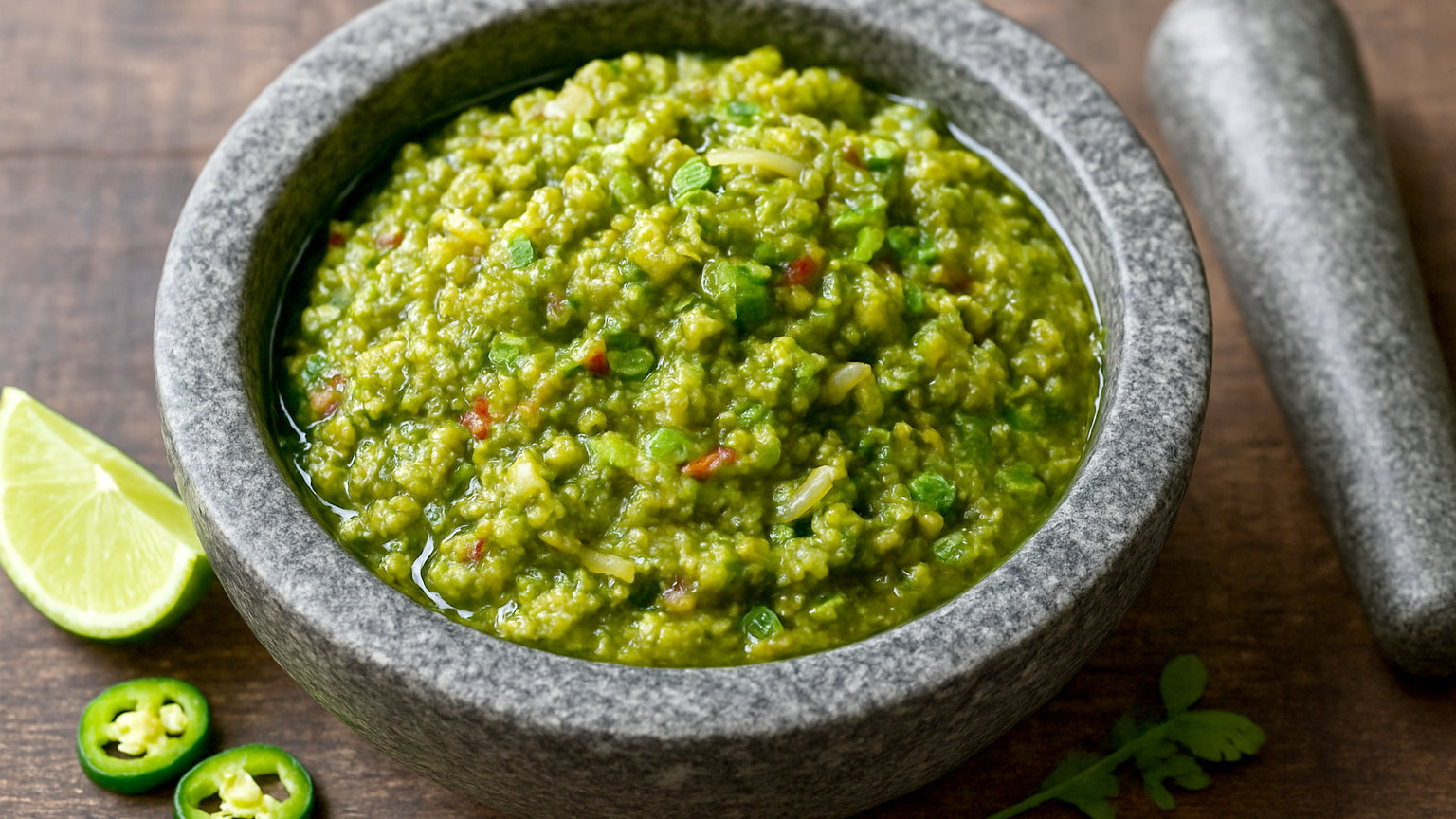
A homemade green curry paste is a different ingredient from a jarred one, not a better version of the same thing. It is brighter, greener, more herbal and considerably more aromatic, and it takes around twenty-five minutes of work.
Pestle and mortar or blender?
A heavy granite pestle and mortar gives the better result, because pounding ruptures cell walls and releases oils where a blade cuts and bruises. The paste comes out smoother, drier and more intensely aromatic.
A small blender or spice grinder works and is far quicker. The paste will be wetter and coarser, and you may need a splash of water to get the blades moving, which dilutes it slightly. If you use one, chop everything finely first.
Which ingredients are non-negotiable?
Galangal, lemongrass, kaffir lime and shrimp paste. Ginger is not a substitute for galangal, which is sharper and more medicinal. Lime zest is not a substitute for kaffir lime, which has a distinct floral quality. Without the shrimp paste the whole thing lacks its savoury foundation.
Most large supermarkets now stock all four, and any South East Asian grocer certainly will. Frozen galangal and lime leaves are excellent and keep for months.
Green curry paste
Makes around 200g, enough for two curries serving four. Twenty-five minutes of work.
Ingredients
- 15 to 20 green bird eye chillies, adjusted to taste
- 3 long green chillies, roughly chopped
- 1 tsp white peppercorns
- 1 tbsp coriander seeds and 1 tsp cumin seeds
- 1 tsp salt
- 3 lemongrass stalks, tough outer layers removed, finely sliced
- 30g galangal, peeled and finely chopped
- The zest of 2 kaffir limes, or 6 lime leaves finely shredded
- 8 garlic cloves and 4 Thai shallots, chopped
- 2 tbsp coriander roots and stems, finely chopped
- 1 tsp shrimp paste
Method
- Toast the coriander and cumin seeds in a dry pan for 90 seconds until fragrant, then cool completely and grind to a powder with the white peppercorns.
- Wrap the shrimp paste in foil and toast it in the dry pan for 2 minutes a side, which mellows it considerably.
- Pound the chillies with the salt first. Salt acts as an abrasive and helps break everything down.
- Add the lemongrass and pound until fibrous and broken down, which takes several minutes and is the hardest part.
- Add the galangal and kaffir lime zest and pound to a paste.
- Add the garlic, shallots and coriander roots and continue until smooth.
- Work in the ground spices and the toasted shrimp paste until everything is a uniform green paste with no visible fibres.
Why pound in that order?
Hardest and most fibrous first, softest and wettest last. Lemongrass and galangal are woody and need the most work, and doing them while the mortar is still relatively dry gives you the friction to break them down. Add the wet ingredients early and everything slides around instead.
How long does it keep?
Two weeks in the fridge under a film of oil, and six months frozen. Freeze it in an ice cube tray and two or three cubes is a portion for four, which makes a single session of pounding worth several dinners.
Can you make it without shrimp paste?
Yes, and a teaspoon of light miso or a tablespoon of fermented bean curd stands in reasonably well. Both bring the fermented savoury depth that shrimp paste supplies. The result is recognisably a green curry paste, though slightly lighter, and it makes the whole dish suitable for vegetarians.
Why toast the shrimp paste?
Because raw shrimp paste is pungent to the point of being difficult, and toasting it mellows it into something savoury and rounded. Wrapping it in foil first contains the smell, which is otherwise considerable and lingers in a kitchen for hours. Two minutes a side in a dry pan is enough.
How do you know when it is finished?
When there are no visible fibres of lemongrass left and the paste holds together as a single mass rather than a collection of pieces. Rub a little between finger and thumb: it should feel smooth rather than stringy. Under-pounded paste leaves woody threads in the finished curry.


