The bread in a bunny chow is structural, and choosing well matters more than it would for a side dish. The right loaf is the one most cookery writing would tell you to avoid.
What do you need?
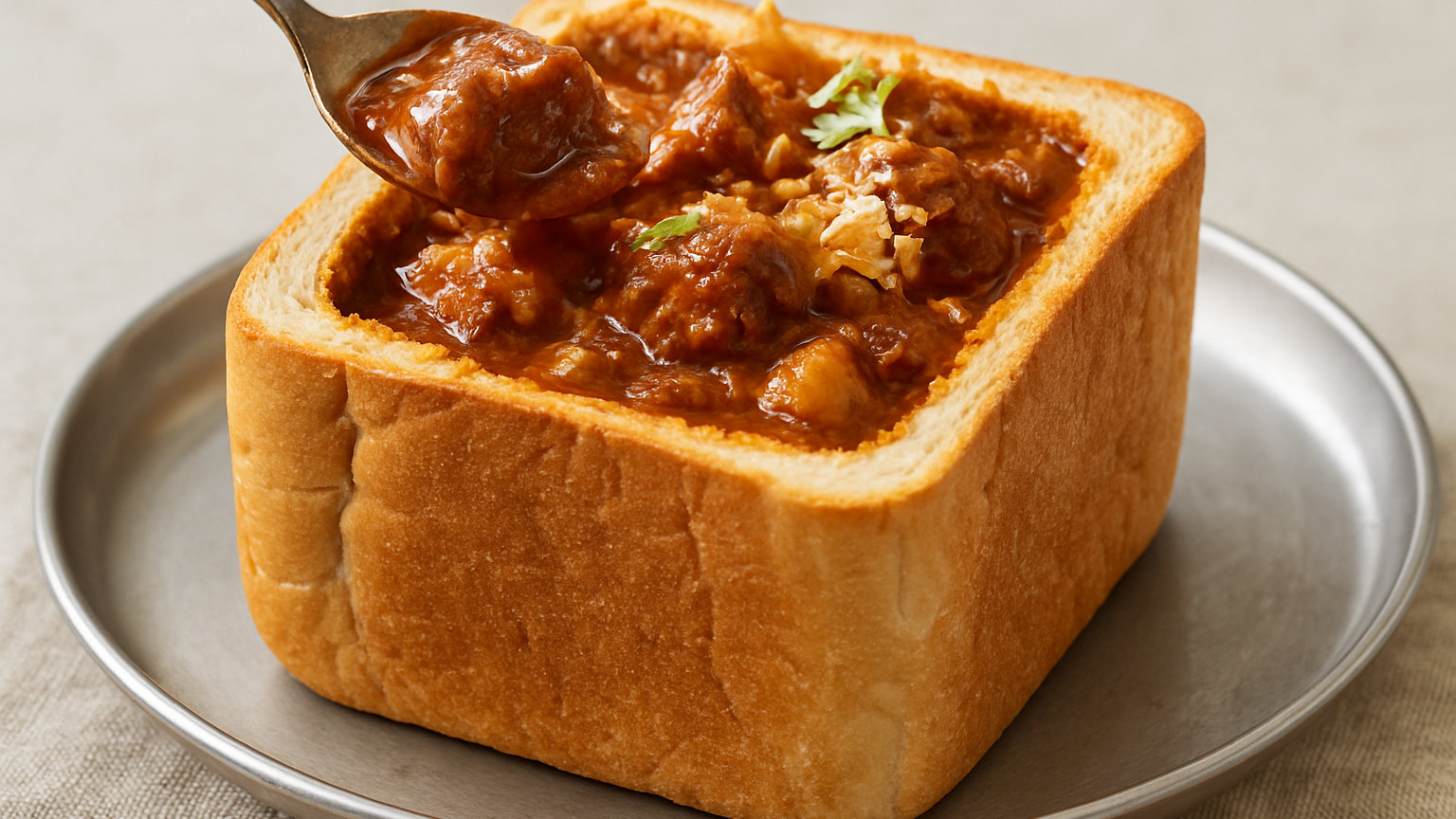
A plain unsliced white tin loaf. Soft, fine-crumbed, with a firm but thin crust and a squared-off shape. The kind sold cheaply in any supermarket.
In Durban this is simply a loaf of bread, and the dish was built around what was cheap and available.
Why not a better loaf?
- Sourdough - too chewy and too strongly flavoured, and it fights the curry.
- Crusty bloomers and batons - the crust is too hard to tear with your hands.
- Ciabatta and open-crumb breads - the holes let sauce leak straight through.
- Wholemeal - the flavour competes and the texture is wrong.
- Brioche or enriched loaves - too sweet and too soft to hold.
What is the crust doing?
Holding the whole thing together. The curry is wet and hot, and the crust is the only thing stopping it running out. That is why the loaf must not be cut through at the base.
A thin firm crust is ideal. Too thick and it is hard to eat, too soft and it collapses.
How do you hollow it?
- Cut the loaf into quarters, or halves for a larger portion, keeping the base crust intact.
- Push your fingers into the cut face and pull out the soft centre in one piece if you can.
- Leave walls around 2cm thick, and a solid base.
- Keep the pulled-out piece, called the virgin, to sit on top.
How do you stop it going soggy?
Cook the curry thicker than you would for rice, and fill the bread at the last possible moment. A bunny chow is assembled and eaten immediately rather than made in advance.
Some cooks toast the inside of the cavity briefly, which is not traditional and does help.
What sizes are ordered?
Quarter, half and full bunnies, referring to how much of a loaf is used. A quarter is a normal portion, a half is generous, and a full loaf is a considerable undertaking.
Is day-old bread better?
Slightly, since it is firmer and holds its shape better when hollowed. Very fresh bread tears rather than pulling out cleanly. A loaf bought the previous day is close to ideal.
Does the shape of the loaf matter?
A squared-off tin loaf is easier to quarter cleanly and gives flat faces that hold their shape. A rounded farmhouse loaf works and produces uneven portions. What matters most is that it is tall enough to hold a decent quantity once hollowed.
What do you do with the crumb?
The virgin sits on top and is eaten with the curry. Any additional crumb pulled out can be kept for breadcrumbs, though most of it goes back on the plate. Nothing is discarded, which is part of the economy of the dish.
Can you use rolls instead?
A large crusty roll hollowed out works as a small portion and it is not a bunny chow, which is defined by being a quarter or half loaf. Restaurants sometimes serve a roll version for convenience, and Durban opinion on it is not favourable.
Does it need to be white bread?
It should be, and this is one of the rare cases where the least interesting bread is the correct one. The point is a neutral soft crumb that soaks up curry without contributing flavour of its own. Anything with character competes with the dish it is meant to contain.
How long should the bread sit before filling?
Hollow it just before filling, since an open loaf dries out at the cut faces within twenty minutes. If you are preparing several, cover them with a cloth while you work. The curry should be hot and ready before any bread is cut.
Does it work with gluten-free bread?
Poorly, since most gluten-free loaves are crumbly and lack the structural crust the dish depends on. The walls collapse and the base gives way under hot curry. Serving the same curry with rice is a better answer than a bread that cannot do the job.