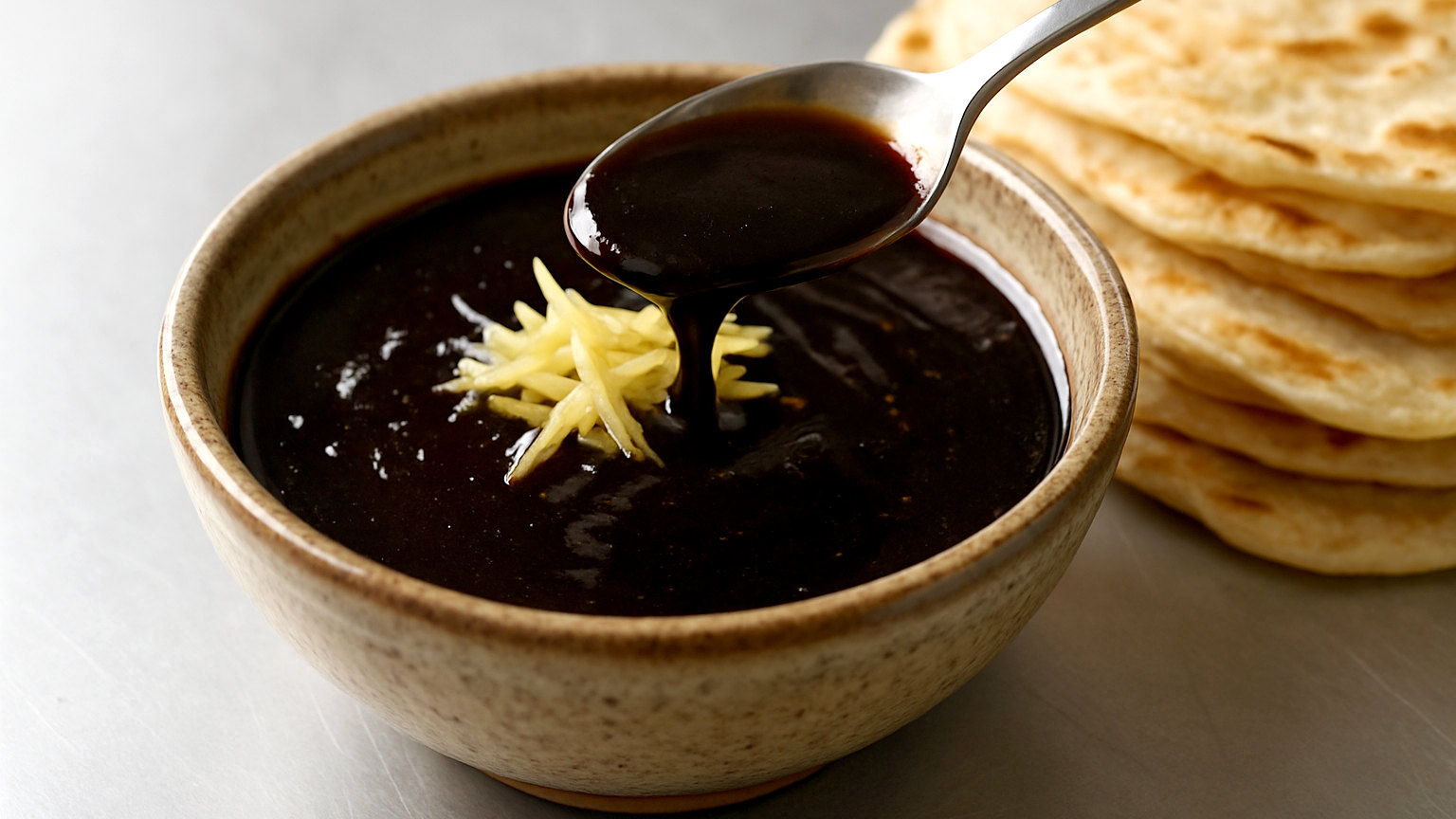
Kecap manis is a thick sweet soy sauce, dark as molasses and roughly the consistency of syrup. It is one of the most distinctive Indonesian ingredients and it appears in a large proportion of savoury dishes.
What is it made from?
Soy sauce heavily sweetened with palm sugar, usually with star anise, garlic and galangal. The palm sugar content is high enough that it is closer to a sweet sauce than to a seasoning.
The word kecap is the origin of the English word ketchup, which arrived through a long chain of borrowing from Chinese via Malay.
How does it differ from soy sauce?
- Far sweeter - palm sugar is the largest component after the soy.
- Much thicker - it pours slowly and coats a spoon.
- Less salty - the sugar dilutes the saltiness considerably.
- Darker - nearly black rather than brown.
Substituting light soy sauce gives a dish that is salty rather than sweet, which is not a small difference.
Where is it used?
Nasi goreng and mie goreng, the fried rice and noodles, where it provides both the colour and the sweetness. Satay marinades and dipping sauces. Semur, the sweet braised dishes. As a table condiment alongside almost anything.
It appears less in gulai and opor, which get their sweetness from palm sugar directly.
How do you substitute it?
Simmer four tablespoons of dark soy sauce with three tablespoons of palm sugar or dark brown sugar until it thickens slightly, around three minutes. Add a star anise and a crushed garlic clove for a closer approximation.
Molasses thinned with soy sauce is a rougher approximation that works in a pinch.
Is kecap asin different?
Yes, and the names are worth knowing. Kecap asin is salty soy sauce, closer to a Chinese light soy. Kecap manis is the sweet one. A recipe specifying kecap without qualification usually means manis in Indonesian contexts.
How should it be stored?
A cupboard is fine before opening and the fridge afterwards, where it keeps for a year. The high sugar content preserves it well. It thickens further when cold and pours more easily at room temperature.
Which brands are worth buying?
Indonesian brands from an Asian grocer are reliable and inexpensive. Check that palm sugar rather than glucose syrup is high in the ingredient list, which distinguishes the better products.
Does it burn easily?
Yes, because of the sugar content, which caramelises and then scorches at a lower temperature than soy sauce alone. In a stir-fry it goes in near the end rather than at the start, and anything containing it needs a lower heat than you might expect.
Can you use it as a marinade?
It is standard in satay marinades and works well, and the sugar means anything marinated in it browns fast on a grill. Watch it closely over direct heat, and consider brushing more on at the end rather than relying on what went in beforehand.
Is it used in curries?
Less than people expect. Gulai and opor take their sweetness from palm sugar added directly, and kecap manis belongs more to fried dishes, braises and satay. A curry made with it would be noticeably darker and sweeter than either tradition intends.
How much do you use?
Two or three tablespoons in a nasi goreng for four, which is enough to colour and sweeten the whole dish. It is potent, and a heavy hand gives something cloying. Add it gradually and taste, since brands vary considerably in sweetness.
Is it gluten free?
Usually not, since most soy sauce is brewed with wheat and kecap manis is no exception. A few brands produce a wheat-free version. Anyone avoiding gluten should check the label rather than assuming, since it is not something most producers flag prominently.
Where should you buy it?
Any Asian grocer, and increasingly larger supermarkets in the world food aisle. Indonesian brands are widely exported and inexpensive. A bottle lasts a long time given the quantities used, and it keeps for a year refrigerated after opening.