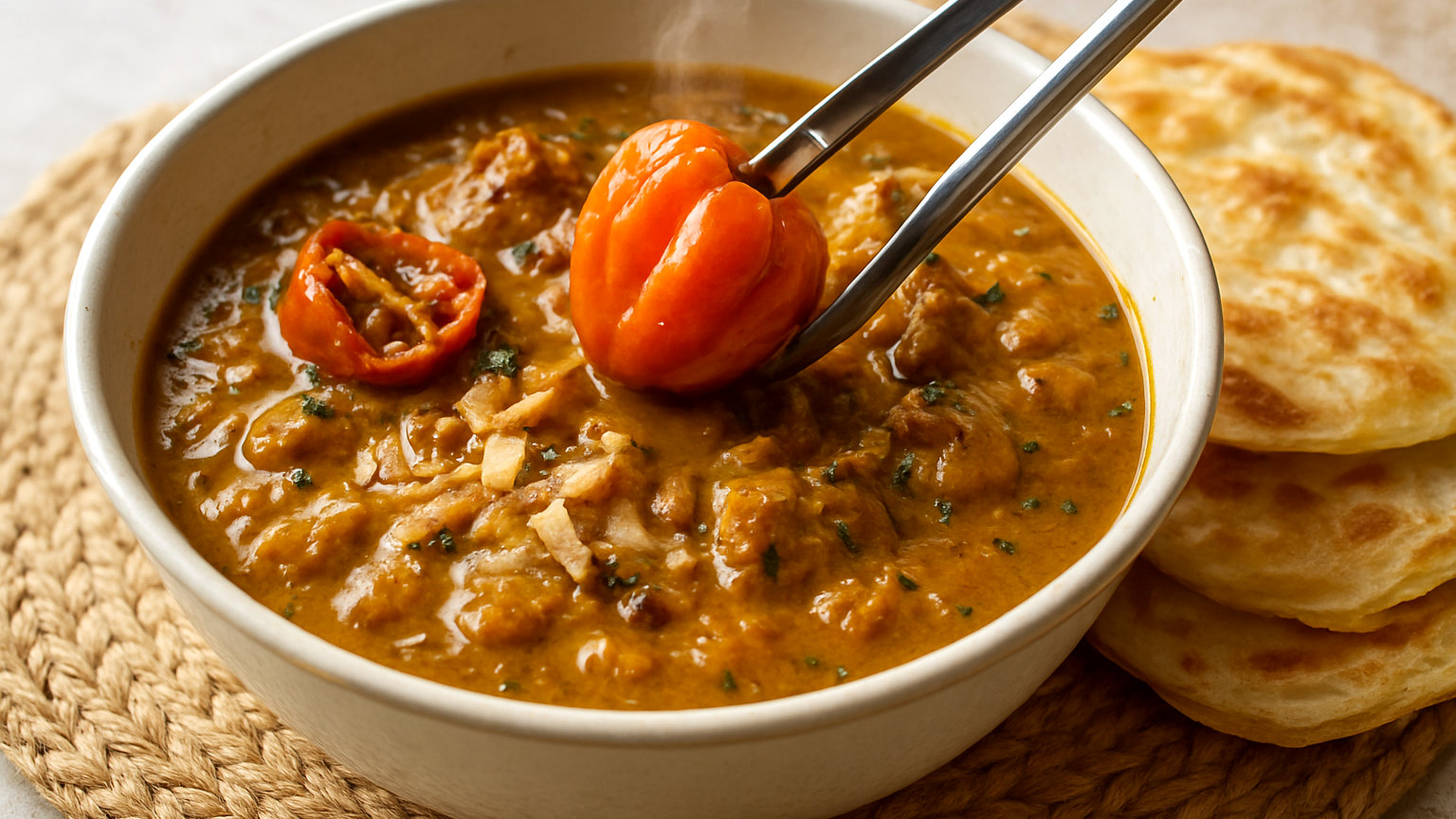
Bhuna appears on British curry-house menus as a dish, usually a drier medium curry. In Pakistani and North Indian cooking it is a technique, and the word describes what you do rather than what you end up with.
What does the word mean?
Bhunao is a verb meaning to fry or to roast, with a sense of stirring continuously over heat. Applied to a curry it means cooking the masala hard, stirring constantly, until the moisture has evaporated and the oil separates out.
Almost every Pakistani meat curry involves a bhuna stage, whatever the finished dish is called.
How do you do it?
- Get the pan and the oil genuinely hot before anything goes in.
- Add the aromatics and the meat and fry hard, turning frequently.
- Add the tomato or yoghurt and keep the heat up.
- Stir near-continuously as the water evaporates, pressing the mixture against the pan.
- Splash in a tablespoon of water whenever it threatens to catch, and keep going.
- Stop when the oil pools clearly at the edges and the masala has darkened.
Why the splashes of water?
Because the aim is to keep the mixture at the edge of catching without letting it burn. A small splash of water drops the temperature for a few seconds, loosens whatever has stuck, and lets you continue frying rather than stewing.
Doing this repeatedly, sometimes a dozen times, is standard practice and it is what develops the depth.
How long does it take?
Ten to twenty minutes depending on how much liquid is in the pan. It is the slow part of a quick dish, and shortening it is the commonest reason a homemade curry tastes thin.
What is the British curry-house bhuna?
A medium-hot dish with a thick, fairly dry sauce, made from the standard base gravy with extra spice and less liquid than a madras. It borrows the name from the technique because the sauce is reduced hard.
It is a legitimate dish in its own tradition and it is not what bhuna means in Pakistan.
Does it apply to vegetables?
Yes. Bhuna gobi, bhuna aloo and similar dishes fry the vegetable hard in a reduced masala rather than simmering it. The principle is identical and the timings are shorter.
How do you know it is done?
The oil separates, the masala darkens noticeably, and the mixture pulls away from the sides of the pan as a mass rather than spreading. The smell changes too, from sharp and raw to rounded and deep.
Judging by those signs rather than by a stated time is the only reliable approach, since pans and quantities vary so much.
Does it apply to chicken and lamb equally?
The technique is identical and the timing differs. Chicken is bhunaoed for eight or ten minutes and is then cooked. Lamb and mutton are bhunaoed for the same length of time and then need an hour of covered cooking before the final frying stage.
What is the difference from a tarka?
A tarka is a brief tempering of whole spices in hot fat, usually poured over a finished dish. Bhuna is a sustained frying of the whole masala with the main ingredient in it. Both use hot fat and they happen at opposite ends of the cooking.
Why does the masala darken?
Because the sugars in the onion and tomato caramelise once the water has gone, and browning reactions between the proteins and sugars produce new compounds. That colour change is a reliable indicator that the frying stage has done its work rather than merely reduced the liquid.
Can you overdo it?
Yes, and the failure is scorching rather than over-frying. Once the oil has separated and the masala has darkened, continuing to fry hard achieves nothing and risks catching. Move on to the next stage as soon as the signals appear.
Does it work with a jarred paste?
Partly. Commercial pastes contain more water than a fresh masala and need longer to fry down, and many contain thickeners that prevent the oil separating cleanly. The technique still improves them noticeably compared to stirring them into liquid.