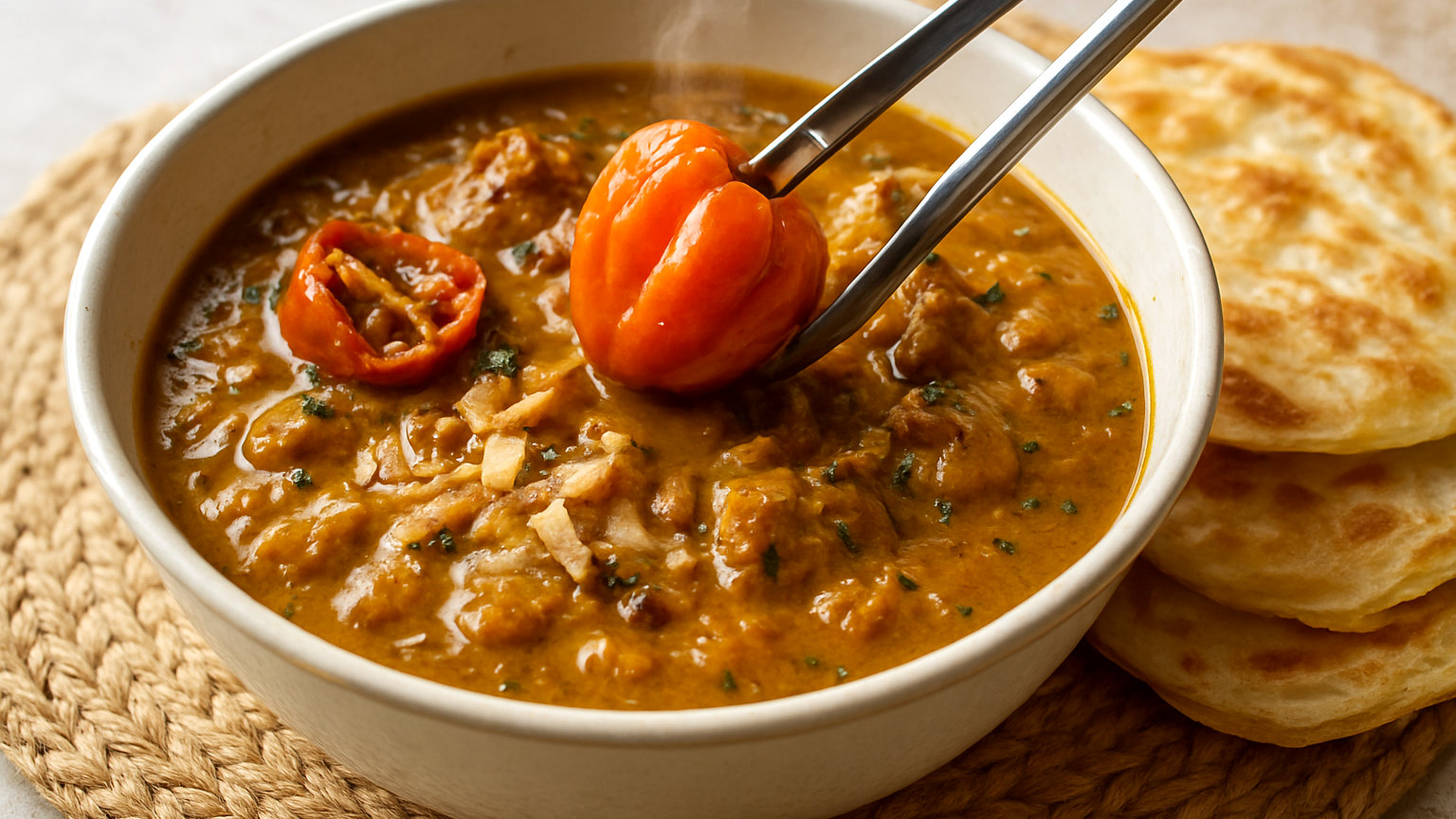
A great deal of British curry cooking is gentle: soften, simmer, wait. Pakistani cooking of the karahi and bhuna family works the other way, cooking hard over a fierce flame and finishing in half the time.
What does high heat achieve?
It drives water off quickly. Tomatoes, yoghurt and meat all release liquid, and until that liquid has gone the contents of the pan are effectively boiling rather than frying. Nothing browns and no oil separates while there is water present.
A fierce heat gets past that stage in twelve minutes where a gentle simmer takes forty, and the browning that follows is where the flavour is.
Is it the same as reducing?
Related but not identical. Reducing concentrates what is already there. Frying hard creates new compounds through browning that simply do not exist in a stewed dish, however long it cooks.
That is why a hard-fried karahi and a slowly simmered curry made from identical ingredients taste noticeably different.
What is the visual signal?
Oil separating and pooling at the edges of the pan. It is the standard marker across Pakistani and North Indian cooking, and it means the water has gone and the masala is frying rather than boiling.
A cook watching a pan is waiting for that, not for a clock.
Which dishes are cooked this way?
- Karahi - the clearest example, cooked hard from start to finish.
- Bhuna - named for the technique itself.
- Handi - fried hard, then finished more gently with cream or yoghurt.
- Most everyday meat curries - the masala stage is always fried hard.
Which are not?
Nihari and haleem, both of which cook for six hours or more and are the deliberate opposite. Both still begin with a hard-fried masala, so even the slow dishes carry the technique at their base.
Aloo gosht and other everyday curries sit in between, fried hard first and then simmered.
Does the pan matter?
Considerably. A wide heavy pan with plenty of surface area lets water evaporate fast and holds its temperature when cold ingredients go in. A deep narrow saucepan traps steam and the contents boil rather than fry however high the flame.
Does it need more oil?
Yes, and this is where domestic cooks flinch. Six tablespoons for four portions is normal for a karahi. The oil is the frying medium, and a dish cooked hard in a thin film of oil will catch and scorch rather than fry.
Much of that oil ends up visible on the surface at the end, which is correct rather than excessive.
Does it change the texture of the meat?
It browns the surface, which a gentle simmer never does, and that browning is a flavour in itself. What high heat does not do is tenderise, so any cut needing time still needs it. A mutton karahi is cooked covered first and then fried hard, rather than being fried hard throughout.
Is it harder to get right?
It demands more attention, since a pan at this temperature will catch within a minute if left. What it does not demand is judgement about timings, because the visual signal of oil separating tells you when to move on. It is more active and less uncertain.
Can you do it on a domestic hob?
Yes, though commercial burners run considerably hotter and the timings in restaurant kitchens are shorter. At home, use the widest heaviest pan you own on the largest burner, cook in a smaller quantity than feels efficient, and accept that it will take a few minutes longer.
Is it healthier or less so?
Neither straightforwardly. The oil quantity is high and a good deal of it remains visible on the plate. Against that, the cooking time is short, there is no cream or coconut, and the dishes are meat and vegetable rather than starch-heavy. It is a different balance rather than a better or worse one.
Does it suit an induction hob?
Well, since induction delivers heat efficiently into a heavy flat-based pan. What it does not suit is a traditional round-bottomed karahi, which needs a gas flame or a wok ring. A flat cast iron pan on induction is the practical combination.